

VFX bidding turns a creative brief into a defensible scope, schedule, staffing plan, and price.
It explains what the studio expects to build, how much work each department will perform, when the work can happen, and which assumptions support the estimate; to give production a usable baseline once the project is awarded, protect margins and cash flow because the studio can see where its money will be spent, and test whether the requested schedule fits the available crew. A clear bid also creates alignment between the studio and the client because it allows them to share the same definition of the work.
The main challenge is that a VFX bid is a production model created before the studio has all information, by definition: a studio can receive an edit containing 300 shots and a delivery date six months away, while quality remains unknown. It's not as simple as taking a shot count and multiplying it by an average price because creative work is inherently hard to estimate: your studio needs a competitive number, but a low bid can be later crushed by overtime, unplanned staffing, repeated reviews, or disputed change requests.
The good news is, we have a great methodology backed by real production data for VFX bidding using our experience at CGWire as a production tracker.
1. Establish the Bidding Brief
First, the quality of a bid depends on the quality of the information supporting it, even if it's incomplete. A studio estimating from a script and an early edit has a different level of confidence from a studio receiving final plates, previs, references, and technical specifications. Scripts, storyboards, edits, plates, concept art, and previs each answer a different production question: the edit defines shot count and duration, concept art informs asset complexity, and plates reveal tracking, roto, cleanup, and integration requirements. Technical specifications carry the same financial weight, since resolution, frame rate, handles, color pipeline, naming conventions, and delivery formats all affect effort, and a project delivered in several color spaces and resolutions creates additional editorial, rendering, quality control, storage, and delivery work.
Target dates alone rarely provide enough detail, because milestones, review frequency, and client turnaround determine how work can flow through the studio. For example, a client taking five working days to approve animation changes the schedule differently from a client providing daily feedback. For this reason, schedule information belongs in the bidding brief just as much as creative and technical details.
Missing information can become manageable when the studio records it as an assumption: if the final number of characters remains open, the estimate can identify the number and type of assets included. Confirmed and provisional requirements need separate treatment because they carry different levels of risk: a confirmed 4K delivery requirement can enter the cost model directly, while a possible 8K marketing version belongs in the assumptions or options because its cost remains uncertain. Recording assumptions this way gives the client a clear opportunity to correct the model before award.
Every bid also benefits from a validity period and a precise creative package reference. An estimate based on edit version 12 becomes unreliable after version 18 adds shots, extends durations, and changes sequence structure. Version control allows the studio and client to trace the commercial proposal back to the material that informed it.
2. Break the Project Into Biddable Units
A shot is easier to estimate when the studio describes the work inside it. Two shots lasting four seconds can require radically different resources: one could involve a simple screen replacement, while the other could require a charater, water physics, and full CG environment integration. A bid shot list connects every item to an edit reference and timecode to prevent ambiguity when shot names change or the edit evolves and lets production later compare the awarded scope with the current cut.
Each shot can then be separated into the tasks it actually requires: cleanup, tracking, matchmove, layout, animation, FX, lighting, rendering, compositing, and so on. Supervision, editorial, data management, quality control, and delivery also contribute labor even though they don't produce visible pixels.
A character usually needs design, modeling, texturing, rigging, grooming, and look development before shot production begins, and charging the complete asset cost to the first appearance makes that shot look artificially expensive while hiding the shared value of the asset. Asset work requires separate treatment because it often serves several shots. A sequence with twenty shots using the same digital vehicle illustrates the point: the vehicle build is a one-time asset cost, while animation, lighting, and compositing vary by shot, and separating those categories shows the real effect of adding a shot that reuses the existing vehicle. Shared work can extend even further across episodes or sequences, when a crowd setup, environment, pipeline tool, or simulation template supports a large body of work. The bid can amortize that cost when reuse is genuinely expected, while the assumptions state how much reuse the estimate requires.
Shot duration remains a useful input, but it cannot be the only metric. A two-second destruction shot take much longer to create than while a twelve-second locked-off cleanup shot. The task breakdown reveals this difference before pricing.
3. Classify Shot and Asset Complexity
A consistent complexity scale gives estimators a shared language. Categories like simple, medium, complex, and exceptional work only when each category has observable criteria. Labels without criteria tend to reflect personal intuition and produce uneven estimates. Camera movement (locked camera vs handheld shot) is one useful criterion. Plate quality, occlusion, live-action interaction, simulation needs, asset proximity, photorealism expectations, render expense, and compositing depth, etc. provide additional useful information.
A shot with simple character movement can be easy for animation but difficult for FX. For example, because the character crosses water. Department-specific complexity can thus prevent one label from hiding several production realities. Written rationales strengthen the highest estimates: a producer reviewing an exceptional shot can see that the cost comes from complex hair interactio, which lets supervisors and department leads challenge the same assumptions instead of debating a vague label.
Production structures are more reliable when teams calibrate their categories against representative work: several estimators can rate the same sample shots, compare their reasoning, and resolve differences before estimating the full project. The resulting scale becomes a studio standard rather than an individual preference.
4. Estimate Labor by Task and Department
Labor estimates are more useful when they describe effort at the task level. A single total of thirty artist-days for a shot gives production little information about staffing or dependencies, while an estimate divided across matchmove, animation, FX, lighting, compositing, and review shows how the work needs to flow. Non-artist labor belongs in the estimate too: VFX supervision, production management, coordination, pipeline support, editorial, input and output operations, quality control, and delivery all consume time.
Ten artist-days can happen sequentially, in parallel, or across several weeks of client review: final simulation waits for animation approval, lighting depends on approved assets and stable layout, etc. The schedule needs to reflect those dependencies because they explain why effort and elapsed time are different.
Again, comparable completed work provides stronger productivity assumptions than memory alone. If previous hero creature shots required an average of twelve animation days and eight compositing days under similar conditions, that history provides a defensible starting point that the estimator can then adjust for creative, technical, and scheduling differences.
At CGWire, we have seen how structured production history supports this comparison: Kitsu tracks shots, assets, tasks, statuses, and related production activity, so a studio can compare estimated effort with actual effort on similar work instead of depending on an estimator's memory of past projects.
Audrey Tondre, Production Director at Remembers, described the value of this production record:
"All the valuable data for production tracking already exists in Kitsu."
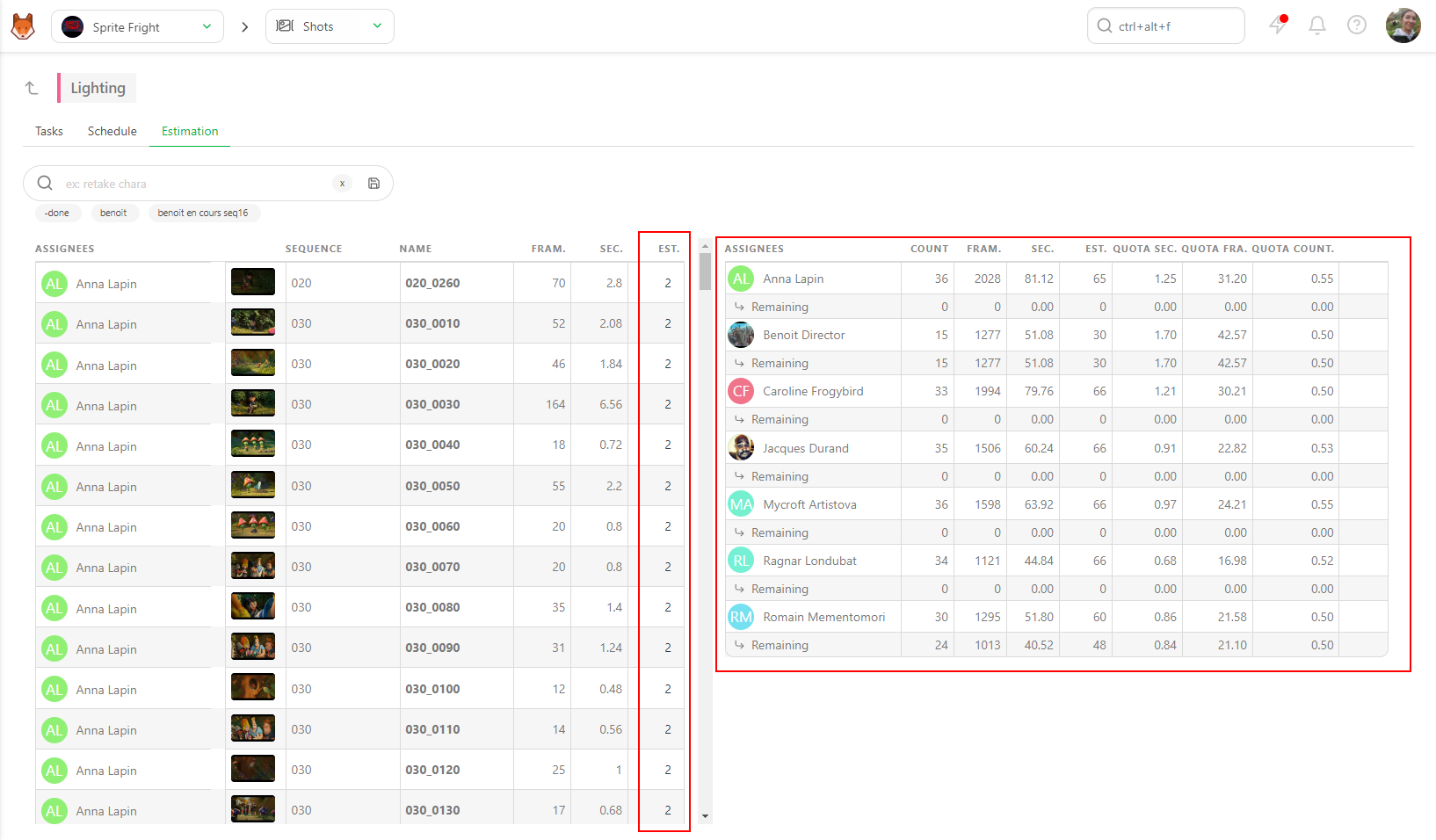
That data is extremely useful for bidding when tasks remain consistent. A studio can identify how long comparable work took, where reviews created delays, and which departments regularly exceeded their original estimates.
5. Convert Effort Into Cost
Effort becomes a commercial bid after the studio applies realistic cost rates. An artist-day has to represent salaries or freelance fees, employer costs, benefits, software, hardware, storage, facilities, utilities, and operational support, since a rate covering wages alone understates the real cost of production. Department-specific rates also often provide a more accurate model than one studio-wide averag (e.g senior FX work vs editorial cost structures).
The internal cost rate estimates what the work costs the studio, the billing rate represents what the client pays, markup measures the addition to cost, and gross margin measures profit as a share of revenue. A transparent labor calculation keeps these concepts visible but separate:
Labor cost = estimated days * internal day rateThe broader bid calculation can then follow:
Bid price = labor cost + direct expenses + overhead allocation + risk allowance + profitDirect costs need their own place in the model because they can change independently from labor. Cloud rendering, travel, on-set supervision, scanning, motion capture, specialist vendors, stock elements, plugins, data transfer, archiving, and security requirements all create substantial expenses. Separating compute from labor lets the studio explain the cost driver and adjust the right part of the bid.
A bottom-up model tests whether every task and expense is represented, while a top-down comparison asks whether the result resembles completed projects with similar scope. A major difference between the two signals that the team may have missed work or applied an unsuitable benchmark. Bottom-up and top-down checks provide complementary evidence.
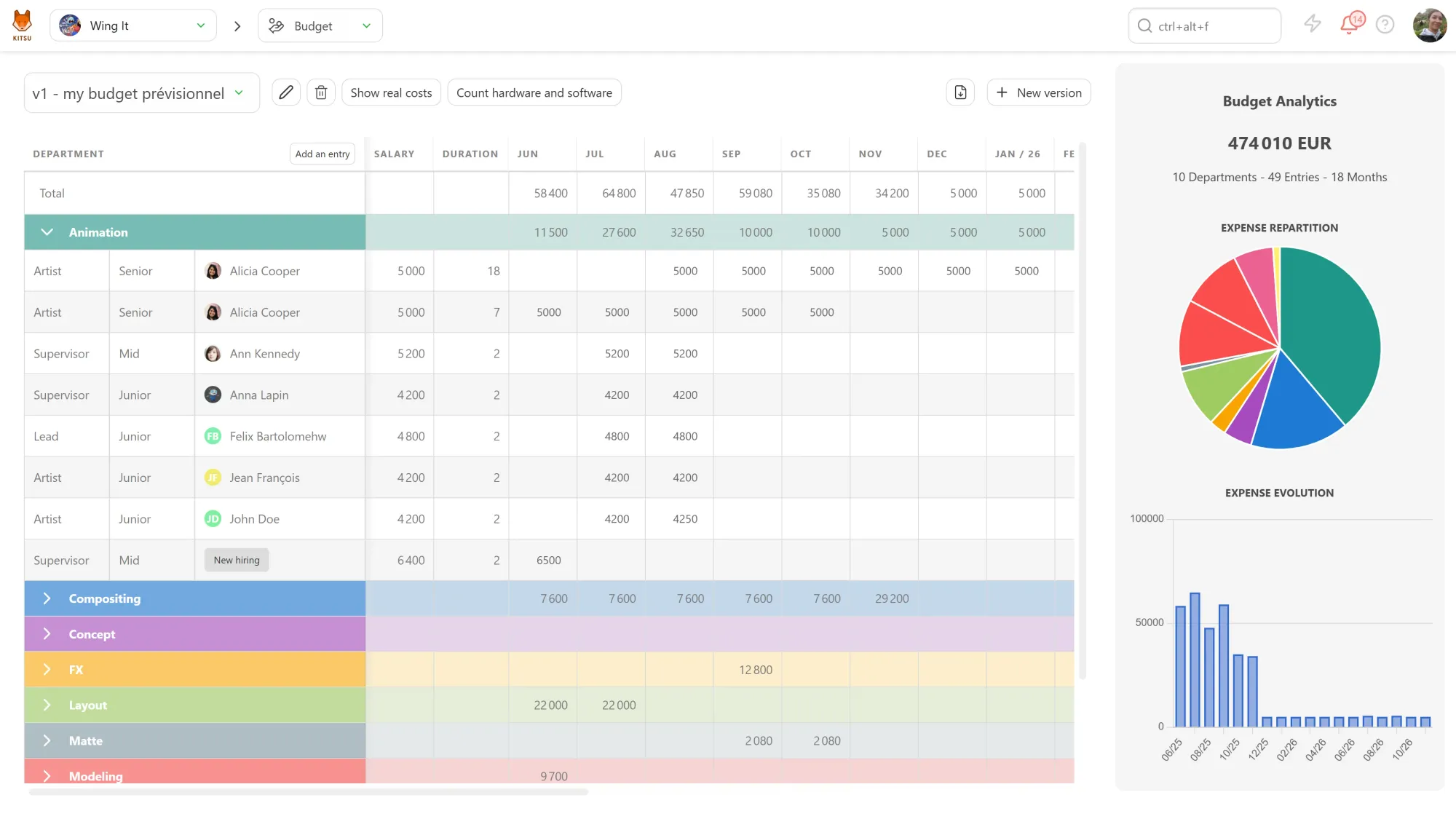
Again, you can use Kitsu to easily forecast different budgets across labor, hardware, and software costs based on real production data per department:
6. Build a Feasible Schedule and Resource Plan
Even if a project contains enough budget for 1,000 artist-days, the delivery date can require those days to happen during a narrow eight-week window: a profitable effort estimate can still produce an impossible schedule. A resource plan tests whether the studio can place the required people at the required time. Dependencies reveal the critical path (asset design may need approval before modeling). Weekly crew requirements make capacity visible too: a bid may require four riggers in the first month, and comparing this plan with existing projects shows whether the studio can staff the work internally or needs freelancers and vendors.
Recruitment, onboarding, and the realities of the studio calendar affect both schedule and cost. A specialist joining the production needs access setup, pipeline training, and creative context before reaching full productivity, so a schedule assuming immediate output from every new artist is not a good forecast. Holidays, weekends, overtime rules, and competing projects also shape capacity: a calendar containing 100 days does not create 100 productive working days for every crew member.
If each approval takes three business days, several sequential approvals consume weeks without adding artist-days, so modeling this delay helps the studio explain why a compressed delivery requires parallel staffing or earlier creative decisions. Client review latency deserves the same treatment as artist work.
Lastly, schedule pressure has identifiable financial consequences. Not all clients are aware of this or care. Overtime, extra supervision, external vendors, cloud rendering, and parallel crew all increase cost. When the requested date conflicts with the proposed budget, the bid needs to show the staffing or scope change required to restore feasibility.
7. Quantify Uncertainty and Risk
As previously mentionned, risk is easier to manage when the studio names it explicitly: incomplete creative information, unconfirmed shot counts, unknown plate quality, untested techniques, uncertain asset reuse, client availability, vendor dependencies, currency exposure, infrastructure limits... they can all change the final cost. A risk register connects each uncertainty to its potential effect e.g unknown plate quality might increase cleanup effort.
Selective contingency produces a clearer model than one unexplained number across the full bid. For example, a stable screen replacement sequence needs little risk allowance, but a photoreal creature interacting with water is more complex, so the contingency follows the location of the uncertainty. Scenario estimates help further when one number would imply false precision. For example, a best-case scenario could assume strong plate quality and two review rounds, the expected case would include normal cleanup and three rounds, and a high-risk case could reflect late plates, additional versions, and a longer approval cycle.
Technically uncertain sequences can also justify paid tests or proof-of-concept work: a short development phase could provide evidence about render costs to give the studio and client a stronger basis for committing to the larger production.
8. Define Assumptions, Exclusions, and Change Control
Assumptions give the bid clear operating conditions: review rounds, feedback turnaround, plate delivery dates, asset reuse, maximum resolution, shot length, included versions, and final deliverables all affect cost, so writing them down creates a shared commercial reference. A studio may price a sequence on the assumption that the client provides consolidated feedback within two business days; if feedback arrives from several stakeholders over two weeks instead, the production experiences additional coordination and schedule pressure that the written assumption makes measurable.
It's not unheard of to see some clients request deliverables outside the original scope. Exclusions define boundaries that clients might otherwise infer differently. If you don't write those down, you expose your team to crunch time.
Scope change needs an operational definition. For example: new shots, longer durations, re-edits, reopened approvals, etc. All additional requests change the work model, and each event affects several departments even when the client request sounds small. A change assessment should explain this chain to keep the commercial impact tied to actual production work.
A structured change-order workflow preserves alignment. The studio documents the request, estimates cost and schedule impact, receives written approval, and updates the production baseline, which lets production separate original work from approved changes. The commercial model would also influence how changes are handled.
9. Apply Review, Markup, and Approval Controls
A multidisciplinary review catches bid errors. Creative supervision can validate the interpretation of the brief, production can test task estimates and scheduling, department leads can challenge complexity ratings, and pipeline and finance can examine technical cost and commercial structure. Missing departments are a frequent source of underbidding. Cross-functional review exposes problems because each reviewer evaluates the bid from a different operational perspective and can trace shared work throughout the pipeline.
An estimate that saves half a day across 400 shots removes 200 artist-days from the budget, and a department lead can compare that assumption with recent production experience to explain whether the expected speed is realistic. Finance review protects the commercial calculation as well. Productivity assumptions deserve direct scrutiny because small errors scale quickly.
If the market price sits below the sustainable cost, management should adjust scope, schedule, margin, or strategic rationale consciously. Market expectations provide useful context, but operational reality still defines the studio's exposure.
10. Present the Bid Clearly to the Client
A strong client presentation should be able to explain the production model without overwhelming the reader. The executive summary states total price, schedule, scope, assumptions, exclusions, and bid validity, to give the client a way to understand the proposal before reviewing detailed costs. The cost breakdown should match the level at which the client can make decisions, since sequence, department, asset, or milestone views often provide useful transparency, while internal salaries, utilization assumptions, and sensitive rate calculations can remain inside the studio's working model. Cost drivers deserve explanation too, since a large total rarely tells the client where choices exist. Once those drivers are clear, the client can evaluate creative or scheduling alternatives.
If applicable, you can make your bid proposal stronger by giving the client multiple clear options. A full creative version preserves the complete brief, a reduced-scope version simplifies background work or reuses assets, a schedule-focused version adds parallel staffing and compute, and a phased award separates development from execution. Each option needs a consistent relationship between creative scope, technical method, schedule, and price. Clear options show what the client gains and what changes in return.
11. Turn the Awarded Bid Into a Production Baseline
The awarded bid becomes the first production plan. The approved shot list, asset list, task estimates, milestones, assumptions, and budget already describe the expected work, and transferring them into production planning preserves the logic used to price the project.
A studio can then compare effort by task, department, shot type, and complexity category to see which assumptions need revision. Estimate-versus-actual tracking shows where the model succeeds or fails.
A production baseline gives management a live view of commercial performance: actual days, remaining work, approved changes, and current delivery risk can feed the forecast, turning the bid into an active reference throughout production.
12. Improve the Methodology After Every Project
Your production data is key to improve your future bids.
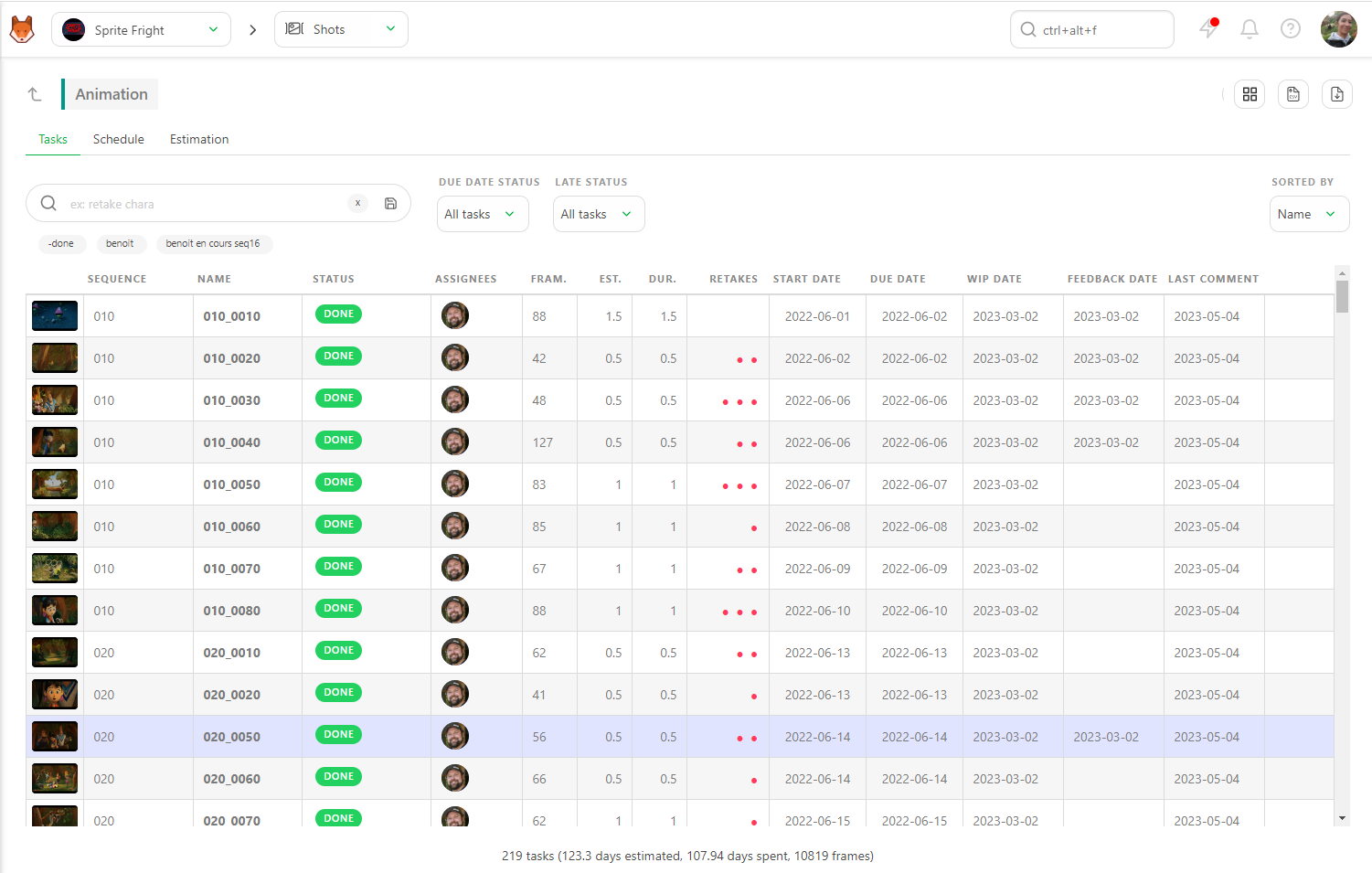
Bidding accuracy improves when the studio reviews completed work systematically. A post-project analysis can compare bid days with actual days, planned staffing with actual staffing, expected reviews with actual reviews, and forecast margin with final margin, to reveal where the original model differed from production. Patterns matter more than isolated overruns.
At CGWire, we see the greatest long-term value when production data survives beyond the final delivery: teams can revisit how many iterations a shot required, which tasks created bottlenecks, and where assumptions proved inaccurate, so that memory can be shared with the whole studio.
A studio can track variance between estimated and actual effort, identify bias, and observe whether forecasts improve over time: bidding accuracy is a measurable studio capability. Experience still matters of course, but structured evidence allows that experience to benefit every future project.
Conclusion
VFX bidding will always involve uncertainty, but it doesn't have to be guesswork. Just treat it as a discipline grounded in real production data.
The strongest VFX bids establish a realistic production plan, create trust with the client, and give the studio a repeatable way to protect quality, schedules, and margins.
Done well, your methodology can turn one of the industry's most stressful processes into a competitive advantage.