
You got a new client project and now it's time to start pre-production.
First problem: how do you present animation concepts to a client without triggering endless revisions?
You need to convince your client the creative choices you make are the right ones, and concept art is here to seal the deal.
First, it's important to understand a strong animation concept can lose its intended impact when the client cannot understand the idea, visualize the final result, or see how their feedback will shape it.
You can spend weeks exploring the story, visual language, and animation techniques. During your presentation, the client sees a selection of images for the first time during a sixty minute meeting. Without enough context, you can easily imagine why they might focus on a color they dislike or assume that a rough animatic represents the final quality.
At CGWire, we've' seen this gap create much confusion. Artists understand how a storyboard evolves into layout, animation, lighting, compositing, and sound. But most client stakeholders have never followed that process: they simply judge what they can see.
A concept presentation, therefore, has a wider purpose than just showcasing creative work: it establishes trust between two parties, aligns expectations, and gives everyone a shared language for making decisions. A client who understands the reasoning behind a direction evaluates it against the brief, and a studio that understands the client's concerns translates broad reactions into useful notes.
The strongest presentations follow a practical sequence: the studio identifies the client's objective, builds a clear creative narrative, selects visuals that support that decision, makes feedback precise, and records what everyone approved.
1. Understanding the Client's Objective
A useful concept presentation begins with a clearly defined objective. A presentation about overall creative direction needs different material from a review focused on character design or animation timing. When several approval questions appear in the same deck, clients move between them without realizing that each decision holds different consequences.
If a studio believes it's presenting three color options for an approved character, the client can think the character's personality and silhouette are still open for discussion. The resulting feedback can potentially reopen weeks of design work because the approval boundary was never stated. A clear opening would explain that the meeting concerns the visual style and that the story structure has already been approved, to give the client a reliable evaluation boundary. It also protects the production from comments that belong to an earlier stage.
Defining that outcome gives the presentation a finish line and allows everyone to recognize when the meeting has succeeded.
The business objective gives that decision meaning. A playful animation for children, a product film for technical buyers, and a brand campaign for social media can use similar visual references while requiring very different creative choices: the intended audience, platform, and communication goal explain why one direction serves the project better than another. Production teams gain clarity when creative reviews remain connected to the original brief.
The approval structure also affects how the studio should prepare the presentation. A marketing manager, agency creative director, brand owner, and legal representative may all attend the same review while holding different levels of authority. When the final approver remains unclear, the studio can receive a provisional approval that another stakeholder reverses several days later. A practical presentation plan identifies who provides specialist input, who consolidates feedback, and who gives final approval to determine which questions belong in the meeting and which conversations can happen afterward.
2. A Clear Narrative for the Presentation
Clients understand a creative direction more easily when the presentation follows the logic of the brief. The opening can restate the communication challenge, audience, and intended response. The concept then appears as an answer to a shared problem instead of an isolated proposal.
For example, a studio creating a film for a complex software product might begin with the challenge of making an abstract workflow feel accessible. The central idea could use a character moving through a transforming visual world. Style frames, transitions, and motion tests would then demonstrate how that idea simplifies the subject for the audience. This sequence creates a clear narrative: The communication challenge leads to the creative idea, the creative idea defines the visual world, the visual world supports an animation approach, and the animation approach shapes the audience experience and carries specific production implications.
Disconnected artwork weakens that narrative because the client has to reconstruct the reasoning alone. A mood board may contain excellent references, but its purpose remains unclear unless the studio explains what each reference contributes. One image can establish lighting, another shows shape language, and a third suggests camera behavior. Review conversations improve when teams explain the function of a reference before discussing its visual appeal. The client can then respond to the intended principle to prevent a situation where they reject an entire direction because they dislike an unrelated detail in one reference image.
Accessible language keeps creative reasoning available to every stakeholder. Technical terms like stepped keys, spline interpolation, parallax, procedural simulation, and subsurface scattering sound familiar inside an animation studio. A client, on the other hand, usually understands the visual result while ignoring technical details. A studio can describe stepped animation as a more graphic movement style with fewer visible in between poses. It can describe a simulation as movement calculated from physical rules, with additional time required for testing and refinement. Plain explanations help clients connect technical choices to what the audience will see and what the production will require.
3. Visuals That Support a Decision
Every visual in the presentation needs to help the client answer the approval objective. Mood boards communicate atmosphere and references. Style frames show a more specific visual target. Character and environment designs clarify form. Storyboards explain sequence. Animatics show timing. Motion and sound references define rhythm.
A large deck can create the impression of thorough preparation but end up making the decision harder. Clients might remember the most striking image instead of the direction the studio recommends. Instead, go for a smaller set of purposeful materials that gives each visual a defined role.
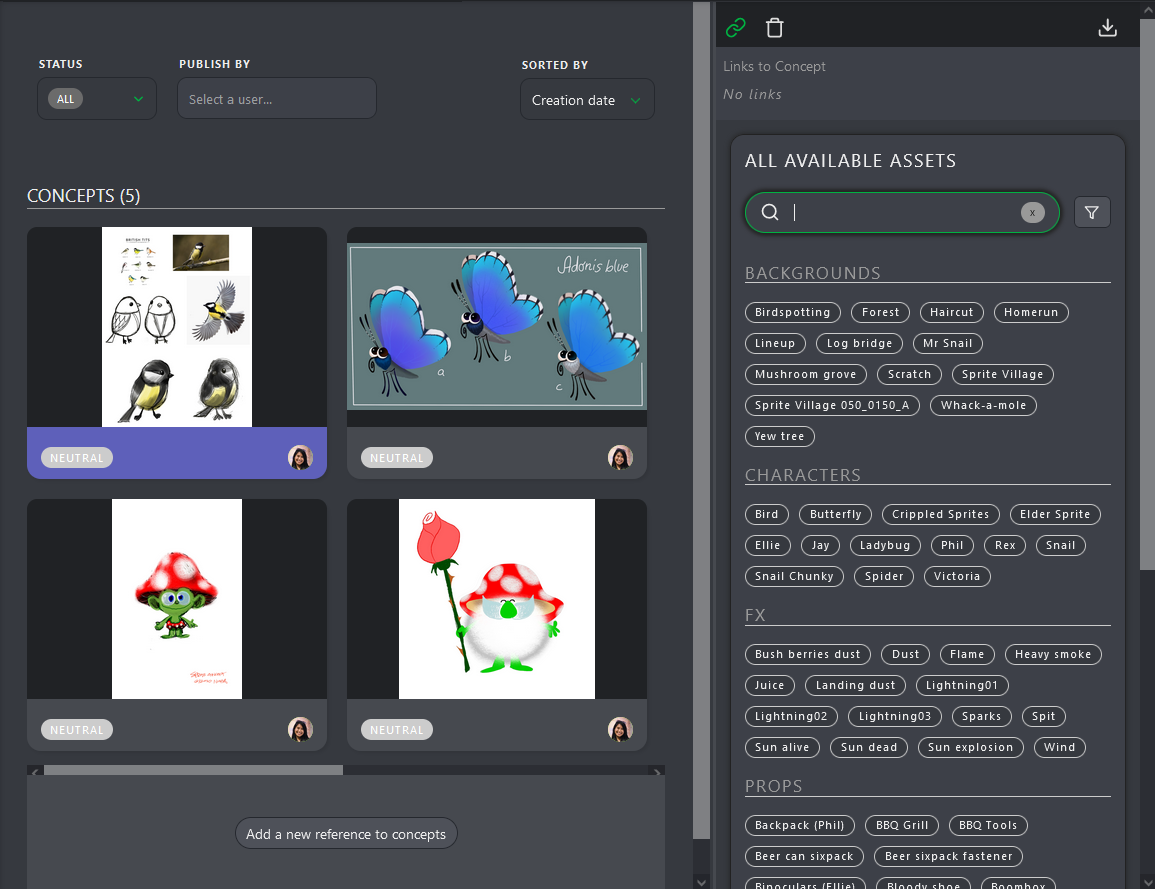
Studios we work with use Kitsu's Concept library to define concepts, then the concepts get linked to actual tracked assets. When it's time to present to the client, supervisors can generate visual playlists to arrange style frames, storyboards, animation tests, and other concept materials in the intended review order. The playlist becomes a guided sequence instead of a folder full of files to help the studio preserve the presentation narrative during both live and asynchronous reviews.
Every visual also needs a clear quality label. A client viewing a rough storyboard may interpret simplified drawings as the proposed design style. A motion test with temporary lighting may create concern about the final atmosphere. These reactions are reasonable when the expected level of finish has not been explained.
The studio can identify a visual as exploratory, representative of composition, or close to final quality. It can also state which elements deserve evaluation at that stage. A rough animatic might support decisions about pacing and shot order, while color, lighting, and detailed acting remain scheduled for later.
Options become useful when the comparison follows consistent criteria. A question about which image the client likes best invites a personal preference. A comparison based on audience fit, brand alignment, readability, emotional tone, and production complexity produces feedback that the studio can apply.
For example, one character direction may feel warmer and more expressive, while another provides a cleaner silhouette at small screen sizes. The client can assess those consequences against the campaign's needs. The studio receives a reasoned decision instead of a simple favorite.
4. Enough Motion to Make the Concept Tangible
Short motion tests can resolve questions that static images leave open. Timing, acting, transitions, camera movement, and effects depend on change over time. A single style frame can show the intended composition, although it cannot prove how a transition will feel or whether a character's performance will read.
A studio doesn't need to animate the entire film to communicate these qualities. A few seconds of character acting is enough to showcase their personality.
The most valuable tests focus on the parts clients find hardest to imagine. A conventional cut between two scenes requires little exploration, but a transition where an environment folds into a product interface carries more technical uncertainty. Testing that moment gives the client confidence and gives the studio useful production information.
This focus also protects the concept budget because the team spends its exploration time on unresolved questions with meaningful consequences. Familiar or already approved elements can remain represented through boards and references.
Early motion work needs explicit expectations because roughness can distract from the intended decision. An animatic contains temporary sound, basic poses, approximate timing, and incomplete transitions. A client who expects polished animation can interpret those temporary elements as creative failures.
You might want to explain during your presentation how the work will evolve through layout, animation, lighting, compositing, and sound to allow the client to evaluate the current stage fairly.
5. Confident Presentations With Space for Discussion
A studio demonstrates creative leadership by presenting a single recommended direction. The recommendation shows that the team has already evaluated the options against the brief, audience, budget, and schedule. Clients usually hire an animation studio for this judgment as well as its execution skills.
The recommendation becomes more persuasive when the studio explains its reasoning. Alternatives can still appear when they represent meaningfully different strategies. Two well defined directions create a useful decision. Several minor variations often shift the conversation toward small preferences before the main concept has been approved.
Planned discussion checkpoints protect the presentation's narrative. Continuous interruptions force the group into detailed feedback before everyone has seen how the concept works. A color question on an early style frame may already have an answer in the following section.
A studio can explain at the beginning that the first checkpoint will follow the creative idea and the second will follow the animation approach. Clients still have room to respond, while the concept receives enough time to become understandable.
Focused questions produce more actionable answers than an open request for thoughts:
- A question about whether the direction reflects the intended audience and tone connects feedback to the brief.
- A question about the least aligned element identifies the source of concern.
- A question about the idea or its current execution helps the studio determine the scale of the revision.
A client may support the concept while feeling uncertain about one rough drawing. Without clarification, the studio could replace a sound idea when the actual issue only requires a refined frame.
Even though you do everything to make decisions logical, you still need to account for the emotional side of it with a solid collaborative workflow.
6. Visual, Specific, and Collaborative Feedback
Feedback becomes actionable when it points to an exact frame, shot, character, or movement. A comment like "make it more dynamic" can refer to either editing pace, camera movement, character acting, composition, effects, or sound. Every interpretation leads to different work.
A more specific discussion could identify that the camera remains static during the product reveal or that the character reaches the key pose too slowly. The artist can act on either note because the location and intended result are clear.
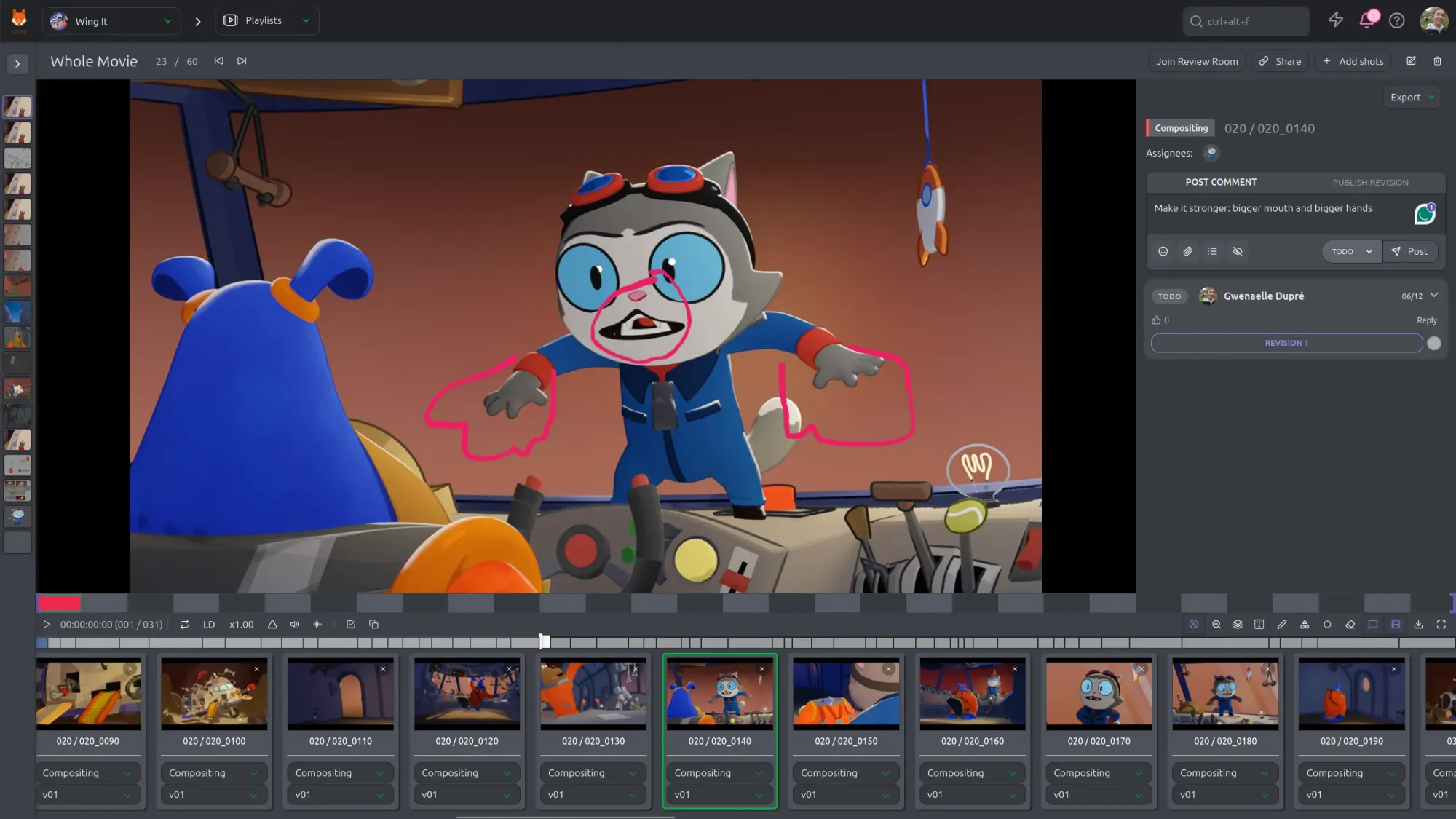
Kitsu's annotation tool supports this type of conversation to facilitate valuable feedback. Clients and artists draw directly over an image or video frame, attach a comment to the relevant moment, and preserve the context for later work. The artist sees the same visual reference that shaped the discussion.
"You can have a meeting with multiple Kitsu users that are all on the same playlist and they can all draw on the same thing. That means you can talk about very specific things at a very specific time."
Chris Unterberg, Founder and Animation Supervisor, Tetsuo Animation
We have found this precision to tremendously reduce interpretation problems. A drawn arc communicates a desired hand movement more clearly than a paragraph. The annotation remains attached to the reviewed material, so the team doesn't need to rebuild the context from memory.
It's also important to note that the status of a comment matters as much as its content: a mandatory brand correction carries a different production weight from an exploratory idea or a stakeholder's personal preference. When every comment appears equally binding, artists spend time implementing suggestions the client never intended to approve. A studio should confirm during the review whether a note is required, open for exploration, or recorded for future consideration to help producers estimate revisions and protect the approved direction from unnecessary changes.
7. A Controlled Review Process
A single feedback channel prevents decisions from fragmenting across email, chat, calls, and private documents. When comments live in several places, it's easy for the production team to miss a late request or implement an outdated note. Stakeholders can also believe their feedback has been accepted when the studio has never seen it.
"Communication with remote studios have been simplified. We can discuss a specific asset or task without exchanging 10 emails. If we have any doubts, we can rely on what is indicated on the platform."
Tristan Mercier, Production Director, Tant Mieux Prod
This quote from Tristan reflects a problem we regularly encounter at CGWire with new customers who used to rely on spreadsheets. A shared review platform creates one visible record. The client can consolidate internal responses before the deadline, and the studio can work from an agreed set of notes. This arrangement gives both sides confidence about which version and comments are current.
Conflicting client opinions need resolution before they become production instructions. If one stakeholder requests a faster pace while another wants more time to read each message and the studio receives both comments as final notes, any implementation will disappoint someone. A clear approval structure gives the client's decision owner responsibility for consolidating those opinions. The studio can contribute creative and production guidance, while the client confirms the final priority.
The final minutes of the meeting should restate the decisions that were made. A spoken recap gives every participant a chance to correct a misunderstanding while the context is fresh. The recap identifies the approved direction, requested changes, deferred ideas, responsible people, and next milestone.
8. Creative Approval and Production Reality
Every concept decision affects schedule, budget, staffing, rendering, and revision capacity. A direction with twelve unique characters requires more design, rigging, animation, and review work than one built around three characters.
Clients can make better choices when these consequences appear during concept approval. A studio might explain that frequent camera changes increase layout and environment requirements, or show that a stylized effect offers the same storytelling value with a more predictable schedule than a complex physical simulation.
This transparency demonstrates that the studio understands how to deliver the idea within real constraints. It's not a creative sacrifice.
The timing of a revision also changes its production cost. Adjusting a character silhouette during concept design affects a few drawings, but the same change after rigging and animation requires updates across many assets and shots. A presentation needs to show where the project currently sits in the production process and which decisions will become expensive to reopen. The client then understands why concept approval needs enough care and why later changes may affect the schedule or budget.
Kitsu production tracking connects approved concepts with assigned tasks, shot statuses, upcoming review milestones, and budget forecasting. Once a direction is approved, production can translate it into visible work across departments. The client and studio can see what happens next without treating the presentation as an isolated event.
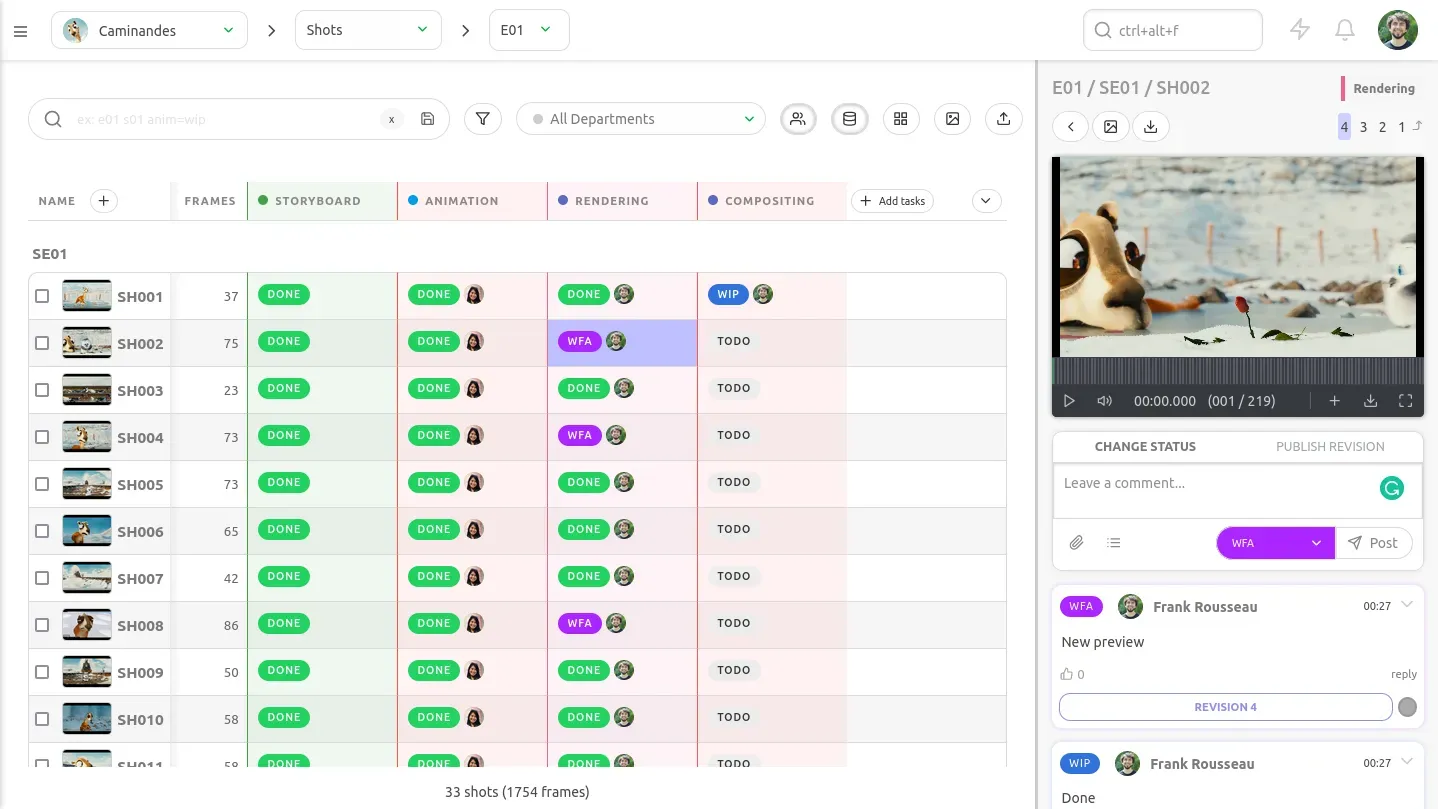
This connection between approval process and production is central to how we think about collaboration. An approved design has practical value when the relevant artists can find it, understand its status, and see the notes attached to it.
9. A Concise Decision Record
As we previously mentionned, a short written summary protects the value of the presentation. People remember conversations differently, especially when a review covers creative, technical, and commercial questions. A concise record gives everyone the same interpretation before production continues.
The summary states the selected direction and confirmed approvals in prose. It can then describe requested revisions, unresolved questions, responsible people, deadlines, and the purpose of the next review to give each stakeholder a clear view of what has changed and what remains open.
A decision record also distinguishes approval from positive conversation. A client is allowed to say that a direction looks promising without giving formal approval, but recording the exact status prevents the studio from starting costly work on an assumption.
"Kitsu has pretty much unified everything and is forcing neater communication not only between artists but from production, management, and clients."
Pete Draper, Head of VFX, Makuta VFX
Shared materials keep the decision record connected to visual evidence. A written note about version three can become ambiguous when several files carry similar names. A note attached to the reviewed image, video, asset, or task preserves the relationship between the comment and the work. This traceability is key to solve conflicts before they even occur.
This shared source of truth supports artists, production managers, supervisors, and clients. Each person can see what was approved, which revisions remain open, and when the next decision will happen.
Conclusion
Successful animation concept presentations combine a persuasive creative narrative, carefully selected visuals, transparent production context, and a structured feedback process. Each element supports the same goal: helping the client make a confident decision that the studio can turn into production work.
To summarize:
- A studio begins from a stronger position when it understands the exact approval required.
- The presentation becomes easier to follow when the concept answers the client's brief in a clear sequence.
- Purposeful visuals and short motion tests make the idea tangible.
- Specific annotations and consolidated feedback give artists reliable direction.
- A written decision record keeps approval connected to the production plan.
- Too many options can transfer creative uncertainty to the client.
Every concept presentation is the beginning of a shared creative process. When clients can see the idea clearly, respond to it precisely, and understand what happens next, approvals move faster. The studio gains a stable direction, and the client gains confidence that the final animation will reflect both the creative ambition and the original business objective.