If you run an animation studio, you might be familiar with this problem: you have talented artists and ambitious projects, but a growing stack of production tracking tools that nobody actually uses. The spreadsheets multiply. The schedules fragment into five competing versions. A director ends up receiving production updates over WhatsApp because the official tool is too painful to open.
That was MIYU Studio's reality before Kitsu. And for studios looking to get serious about production management without sacrificing their creative identity, MIYU's six-year journey with the platform is worth understanding in detail.
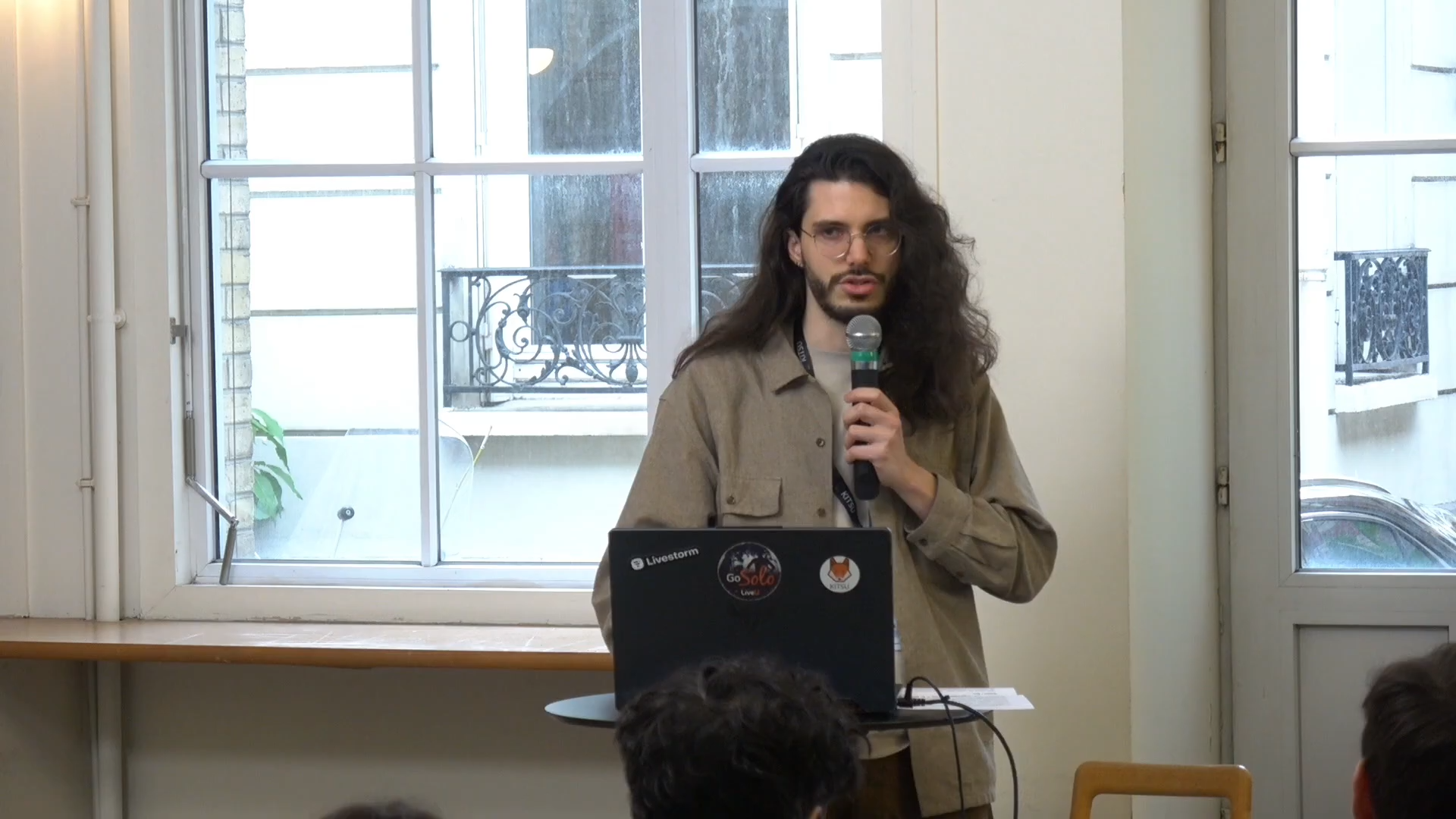
This story was presented at the Kitsu Submit by Cléa Gonay, who joined MIYU as Technical Director roughly five months before the talk. Her fresh perspective gave her a unique vantage point: close enough to understand the studio's culture, new enough to see it clearly.
MIYU Studio is a Paris-based animation production company known for award-winning short films, features, and series. What makes MIYU genuinely unusual is the diversity of its output. In any given period, the studio might be running a children's series with an oil pastel aesthetic alongside an arthouse feature combining rotoscoping and 3D sculpted heads. The art styles span Harmony, TVPaint, After Effects, and Blender. No two projects share the same pipeline.
That is not an accident. As Cléa put it, "the studio's core commitment is unconditional support for the director's artistic vision, which always means adapting to their visual style and their way of working." For a production management tool, that is an extremely demanding context.
1. The Tools That Came Before
To understand why Kitsu worked, it helps to understand what failed:
- Google Sheets was the default fallback, and still appears everywhere in the industry. It has real advantages: it is familiar, flexible, and requires no training. But at production scale, it breaks down fast. Department supervisors maintain their own spreadsheets. Multiple schedule versions move around with no clear authority. Formulas break. Data gets deleted. And every new production requires rebuilding everything from scratch.
- Shotgun (now known as ShotGrid or Flow Production) is the industry reference for large 3D and VFX studios. Cléa described it as genuinely powerful, then noted that she had used the word "powerful" three times in a row about a tool that MIYU ultimately rejected. The problem was not capability but adoption. Shotgun requires a dedicated administrator. Its interface demands significant training investment. And on a co-production with Cartoon Network where Shotgun was imposed on the team, the result was near-universal resistance: "Almost everyone came away with a bad memory of it. Nobody really wanted to use it." A tool that requires a specialist to run it and gets avoided by everyone else is not, in practice, a working tool.
- Cerebro, a Russian-origin platform used for one feature, was described by both the Production Director and Director of Productions as close to a disaster. The director of the film, described as a confirmed technician, never managed to get comfortable with it. Production data had to be exported as CSV files and sent via WhatsApp just so the director could understand the current state of her own film. When a personal messaging app becomes the de facto production dashboard, the official tool has lost its purpose entirely.
- Producer by Toonboom was used briefly by a coordinator before he joined MIYU. His summary: graphically better than some alternatives, but cluttered and hard to navigate. "We're overwhelmed by applications and different environments. Having something simple and clean is a real advantage."
The pattern is consistent: across all four platforms, the problem was not a lack of features. It was a failure of adoption, which points to the central lesson of MIYU's experience.
2. The Core Lesson: Adoption Is Key
Technical sophistication does not guarantee efficiency. The most capable tool in the world has zero value if the team refuses to use it. This is what Cléa calls the "Shotgun trap": a platform so comprehensive that it requires its own specialist, with an interface so complex that artists simply check out.
The cost of that resistance is not just inconvenience but also data quality: if people are reluctant to enter information, or slow to do so, the production data you are working from is unreliable. You are not tracking your production.
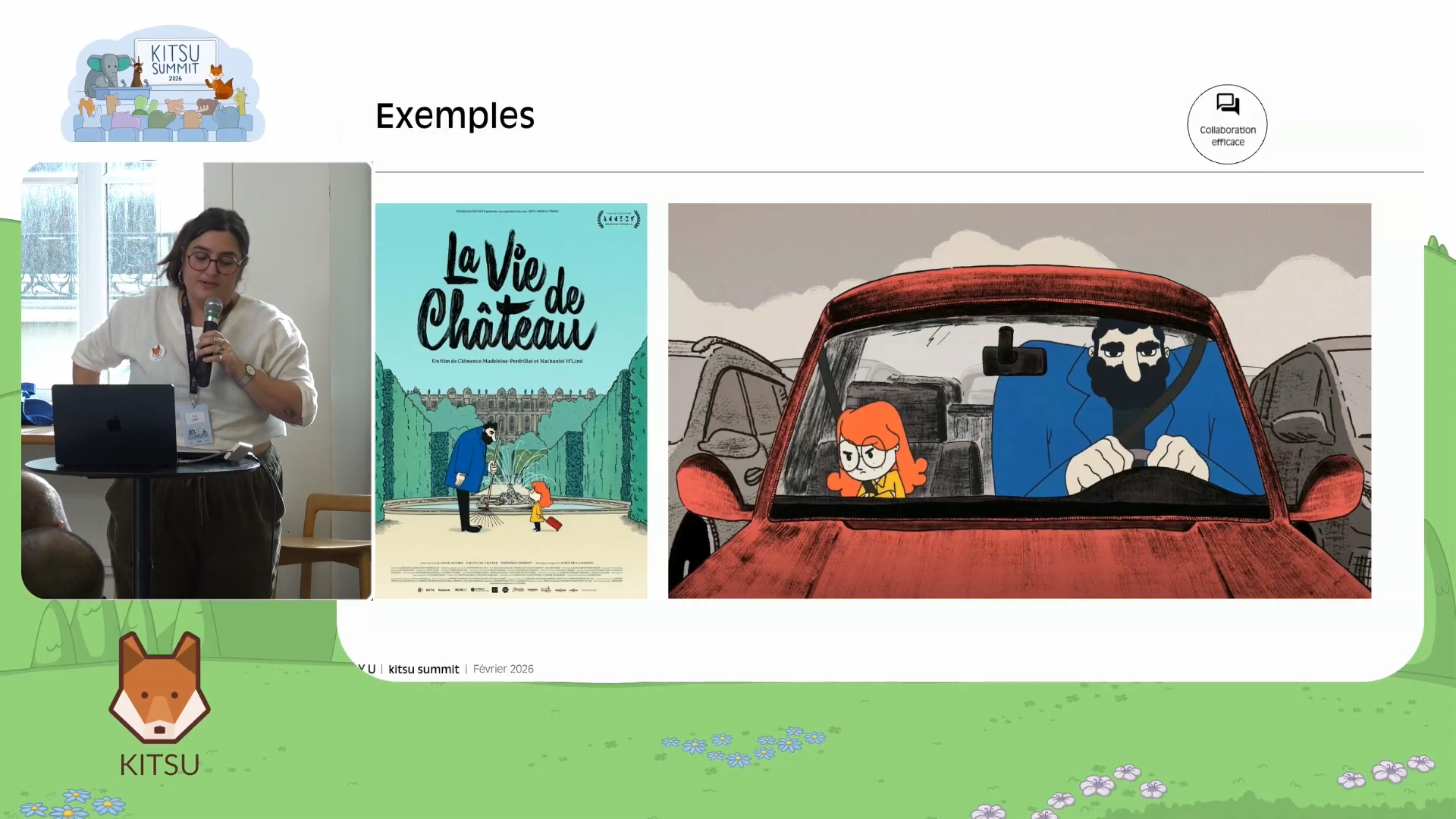
MIYU adopted Kitsu in 2018, starting with a feature film called La Vie de Château. Six years and 46 productions later, the studio has identified four core reasons why Kitsu works.
3. Reason 1: Ease of Adoption
The first and most important strength of Kitsu is simplicity; which, as Cléa acknowledged, sounds obvious but is genuinely rare in production software. Most tools are complex by default. Kitsu made the opposite bet: start accessible, add complexity only when users ask for it.
The practical results are real. Tasks can be created in under 30 seconds. Statuses are fully customizable per project, and MIYU coordinators have embraced that flexibility with creative enthusiasm. Projects can be duplicated from previous productions, so with 46 shows in the system, no one is starting from scratch.
The first Kitsu production at MIYU illustrates this well. La Vie de Château was partly managed from the Valence studio at a time when that team was barely staffed; virtually one intern and one production coordinator, working without close supervision from Paris. If the tool had required a specialist to operate, the Paris office would have had no visibility into what was happening. The fact that those two people ran it successfully on their own is proof of how low the barrier to entry is.
4. Reason 2: Real-Time Data Quality
Simplicity enables something that often gets overlooked: reliable data. Because the interface is accessible enough that artists and coordinators actually use it, information gets entered in real time, meaning production decisions are based on what is genuinely happening, not on approximations.
As Tanguy, MIYU's Director of Productions, put it: "if the information is poor quality―because people are reluctant to enter it―the results are meaningless".
The benefits compound over time. An easy-to-use tool creates a virtuous cycle: real data leads to better decisions, which builds trust in the system, which encourages more consistent use.
5. Reason 3: Flexibility Across Projects
At MIYU, there is a phrase that captures the studio's reality exactly: "We have as many pipelines as we have films." Kitsu's architecture built around the concepts of shots and assets is flexible enough to accommodate genuinely unusual workflows.
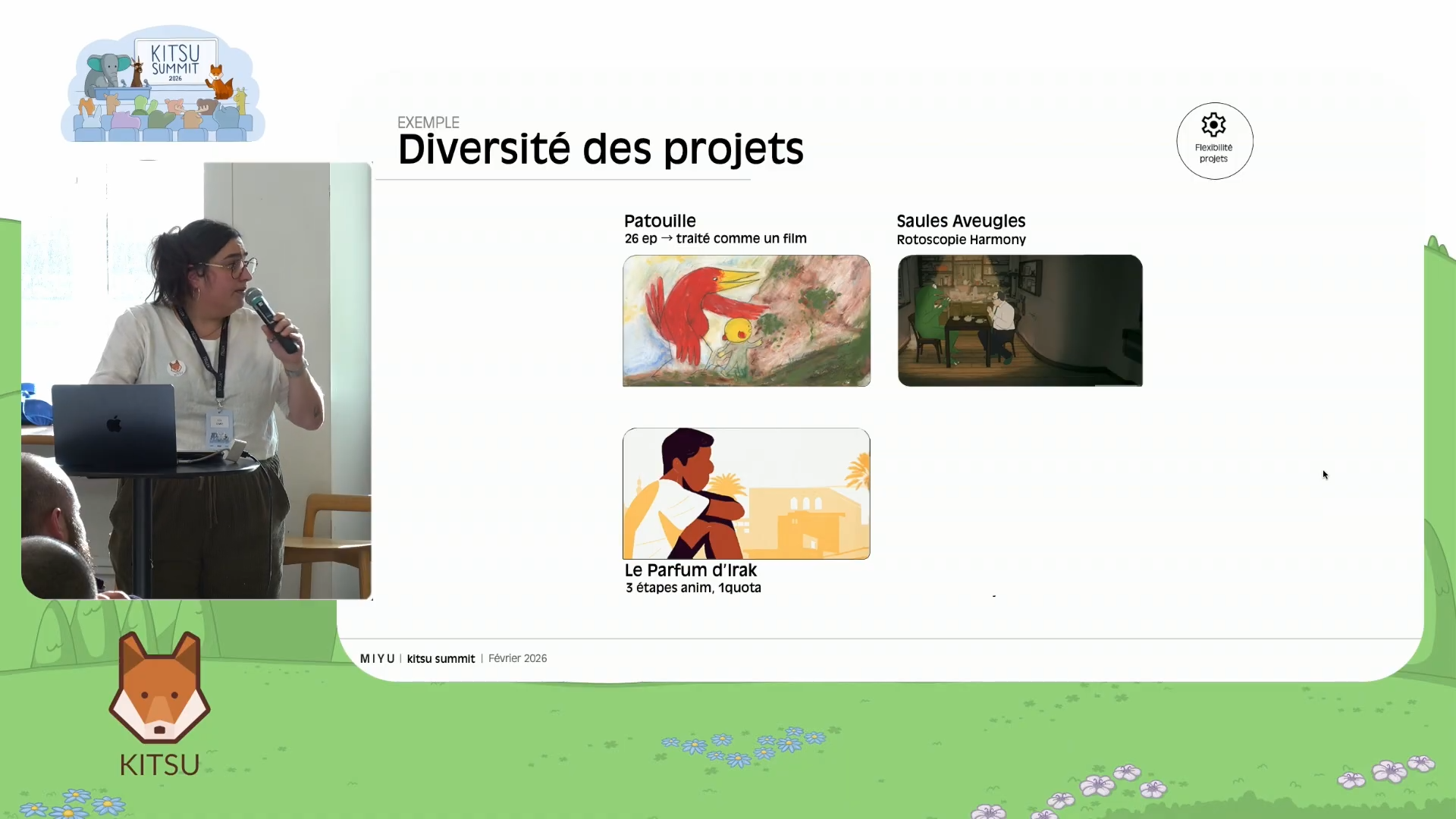
Three examples from recent productions illustrate the range:
- Patouille, a 26-episode children's series with an oil pastel aesthetic, was tracked as if it were a single feature film rather than an episodic series. The coordinator chose to display all shots from all episodes on a single page, giving him a global view of the entire production at a glance. That is not how the tool was originally designed to be used, but it worked without friction. The series had three directors working simultaneously from three different locations, and the unified view kept everyone aligned. The actual production process for Patouille was equally unconventional: frames were animated digitally, printed, hand-colored in oil pastel, integrated with pastel backgrounds, then rescanned back into sequence using a barcode system (which, Cléa noted, never worked quite right). Kitsu tracked all of it.
- Saules Aveugles, Femme Endormie had a production pipeline that simply does not exist in standard industry workflows. Animators worked with 3D sculpted reference heads for movement, then moved into a bespoke "expressions" phase where they would watch actor reference footage and interpret emotions onto the character by hand (eyebrows, eyes, mouth) frame by frame. The pipeline combined rotoscoping, 2D animation, 3D animation, and this custom step. Kitsu accommodated it using custom tasks and shot organization, adapting to the production rather than requiring the production to adapt to it.
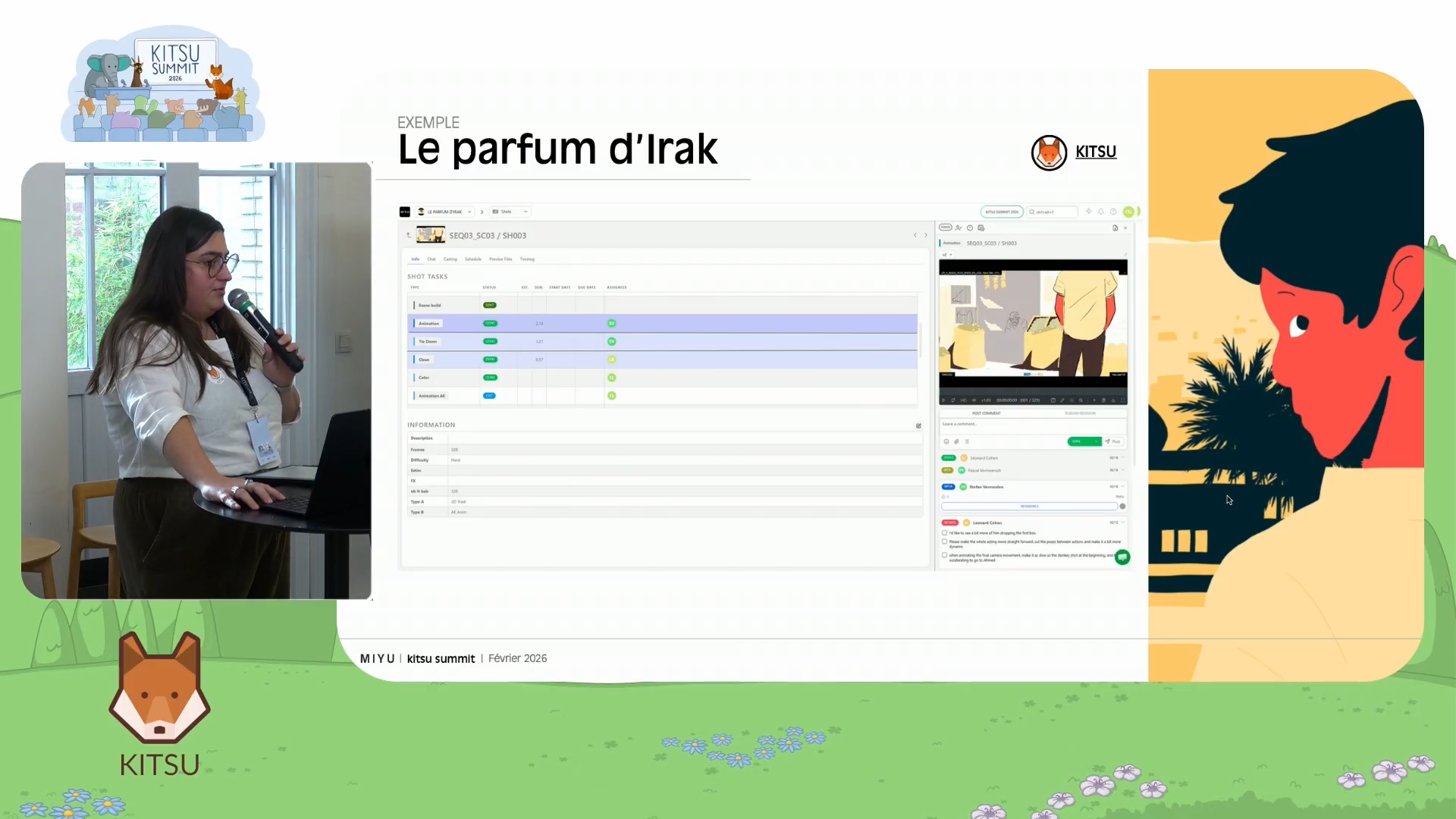
- Le Parfum d'Irak, a French-Belgian co-production, required splitting animation mid-production into three distinct stages: rough animation, tie-down, and clean-up. That restructuring happened without disruption. Cléa also noted that quota tracking for those three stages was managed in a separate Google Sheet. The point is that Kitsu handles the core production stages reliably and integrates with other tools where needed, rather than demanding to be the only system in use.
6. Reason 4: Collaboration Across Distances
The collaboration features of Kitsu (side-by-side version comparison, frame-level drawing annotations, comment threads, and playlist-based review sessions) solve a real problem for studios working across multiple locations or with directors who are rarely in the same room as the production team.
La Vie de Château was a co-direction with one director in Paris and one in Valence or Angoulême. Animation, color, and compositing were happening in three different cities under a tight festival deadline. Kitsu gave all three teams real-time visibility into each other's progress. No daily exports, no waiting for batch video sends. An animator in Valence could see what the compositing team in Angoulême had finished that afternoon.
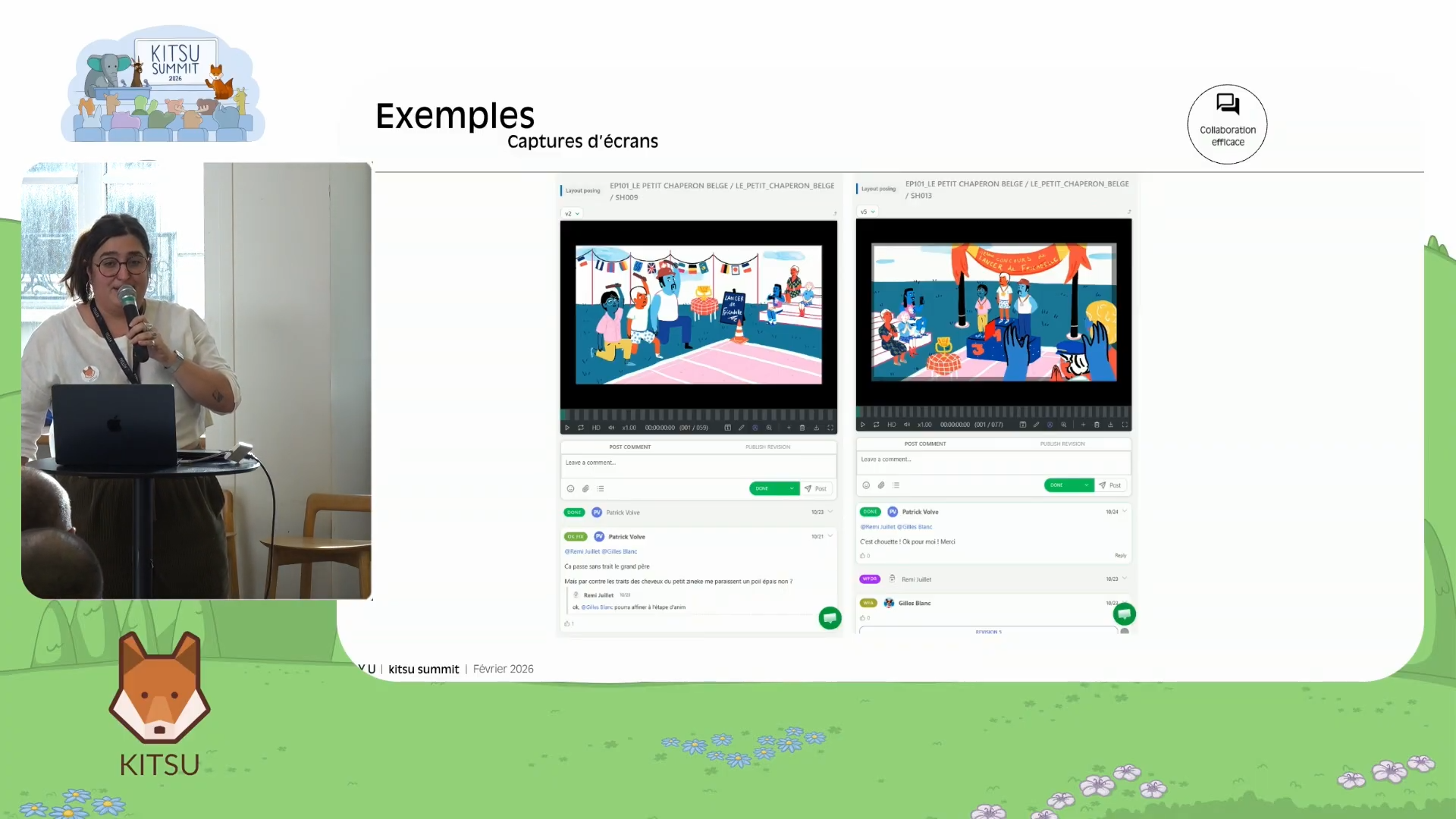
As Tanguy described it, you could see ten shots waiting in the queue and decide that evening to prioritize those when you got home. That kind of visibility creates something beyond practical efficiency: it creates a sense of shared momentum across dispersed teams.
On the current ongoing series, the directors are so busy they rarely open Kitsu themselves. Coordinators build review playlists and send them through. Reviews happen on schedule. Directors can mark shots approved or send them back for revisions in two clicks. That simplicity is not incidental. It is what makes the review loop actually close.
7. The Open Architecture Advantage
Behind the clean interface is a technical foundation worth understanding for studios evaluating production tools. Kitsu is open source, built with documented APIs and a Python client library (Gazu). CSV import and export work reliably. Metadata fields and filters are useful for quota tracking and custom reporting.
MIYU has built internal tools on top of this foundation. One, called Speedline, automates breakdown nomenclature and integrates directly with Kitsu. The studio still uses Google Sheets for global analytics and budget tracking, though Cléa noted with some amusement that the Kitsu roadmap suggests that gap will close before long.
More importantly, the relationship between MIYU and CGWire has been collaborative from the beginning. When Tanguy first adopted the platform in 2018, Kitsu was primarily an asset management tool. Collaboration at scale was not yet fully developed. MIYU sent back two pages of detailed feature requests (role-based review permissions, complex quota filters, and the validation system) and CGWire built them. Where larger vendors treat individual studio feedback as support tickets, CGWire treated MIYU's input as product roadmap contributions. Six years on, both sides are better for it.
8. On Resilience: The Great Deletion
No honest production management story omits its disaster. At MIYU, that came when a coordinator accidentally deleted a task column mid-production, triggering a cascade that made the entire project page unloadable in Kitsu.
Cléa was in bed when the alert came through. Tanguy, the Director of Productions, had posted something on Discord. Within 30 minutes, the project was fully restored because Kitsu's event log captures all modifications in real time. The team rolled back to approximately 20 seconds before the deletion, identified a status update from one minute earlier as the clean restoration point, and locked the project immediately to prevent any further changes during the restore.
The more telling detail: the coordinator had not even flagged the issue to his colleagues. He reported it quietly to the Kitsu support team directly. And it was resolved before most of the studio knew it had happened.
The restore procedure is now fully documented. As Cléa put it: "Anyone can delete as many tasks as they like. We'll be ready."
9. What Comes Next
Cléa identified four areas for continued development at MIYU:
- Post-mortems - After each production, a structured review of what went wrong and what to improve rather than simply moving immediately to the next project.
- Ongoing training - Team members still regularly discover Kitsu features they did not know existed. More systematic documentation and training would reduce that gap.
- More automation - Wherever manual steps can be removed, they should be.
- Continued collaboration with CGWire - The working relationship has been productive enough that deepening it is a clear priority.
Key Takeaways
MIYU's story is not about finding a magic tool. It is about understanding what actually drives adoption and building your production culture around that.
The studios that fail at production management are usually not using the wrong software: they are using software that is too complicated for the people who need to use it every day. Artists are not production administrators. Directors should not need to learn a new operating system just to approve a shot. Coordinators should not need a developer on standby to reconfigure a project mid-production.
Félix, MIYU's Production Coordinator, offered the summary that Cléa chose to end her presentation with: "Kitsu is something malleable." That ability to shape a tool around your workflows rather than shaping your workflows around a tool is what makes the difference between a platform that gets adopted and one that gets worked around.
The goal, as Cléa framed it, is production management that serves creativity rather than hinders it. That is not a soft aspiration. It is a concrete design requirement. And it is achievable.