

To watch the full talk upon which this article is based, check out the video above
When the animated feature film Arco premiered in autumn 2025, the release was met with considerable recognition: a selection at the Cannes Film Festival and a Crystal Award at the Annecy International Animation Film Festival. Behind that success was a small Parisian studio, Remembers, navigating its first feature film with a lean production team and a project management tool most of its artists had never heard of before: Kitsu.
At the Kitsu Submit conference, Audrey Tondre, the production director on Arco, shared an honest and detailed account of how she introduced Kitsu to a studio that was not asking for it, and why it turned out to be exactly the right move.
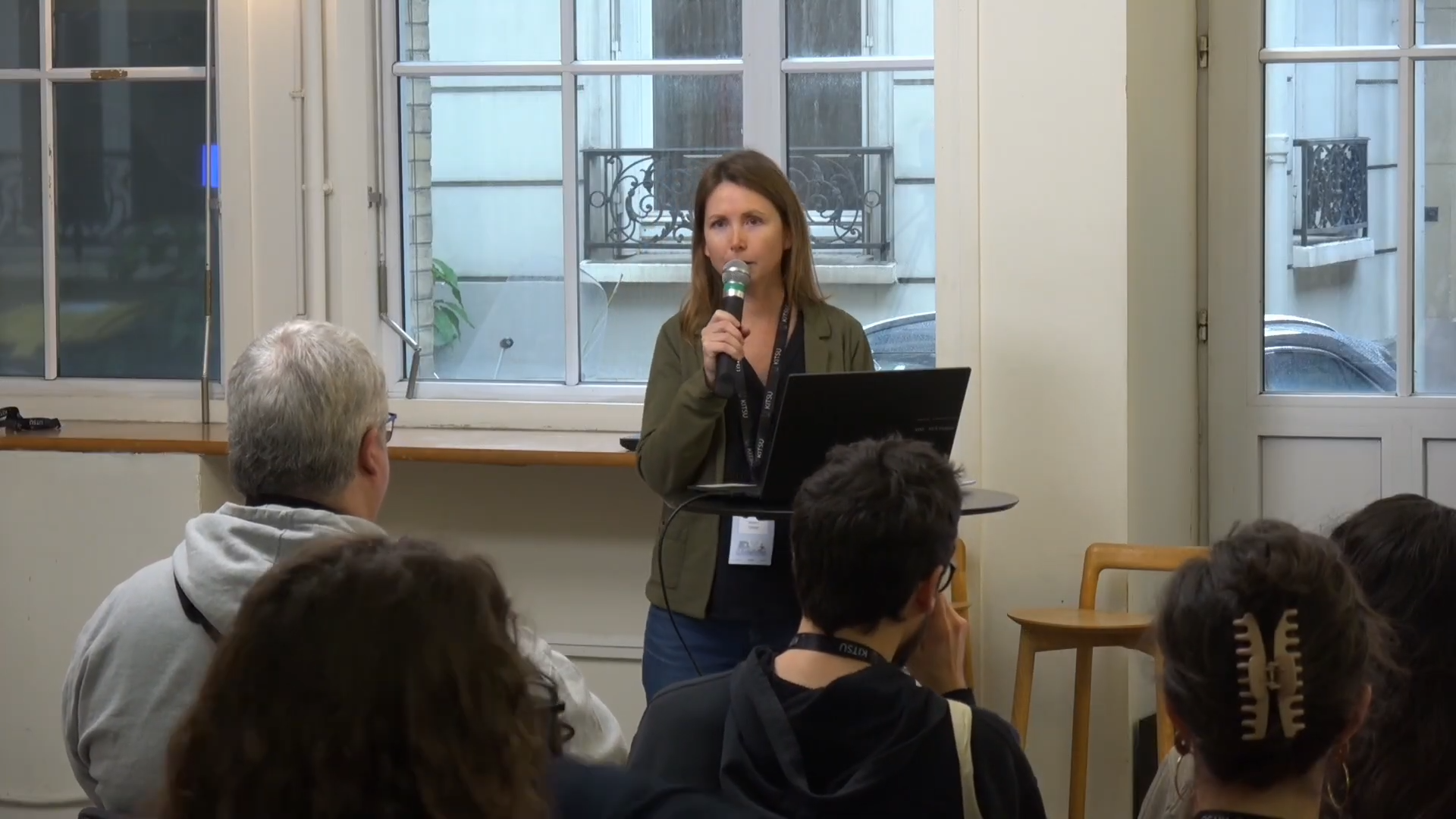
Audrey joined Remembers specifically to produce Arco, a traditional hand-drawn 2D feature directed by Ugo Bienvenu and co-produced by Remembers (which Bienvenu runs with partner Félix de Givry) and the company Mountain (founded by Sophie Mas and Natalie Portman). Her background before this project was almost exclusively in 3D feature films, a world where production tracking tools are deeply embedded in every workflow.
Coming into a 2D studio, producing its first feature was a significant context shift. And that gap between worlds is precisely what makes her story useful for any animation studio looking to grow.
A Studio Built for Small-Scale Work
Remembers had built a strong reputation on short-format projects: music videos, commercials, and short films. The quality of the work was not in question. But the infrastructure for managing a long-form project simply did not exist yet.
"There was no pipeline, no development team. All the space was dedicated to the artists."
The entire film was produced in-house at Remembers, spread across three separate premises in the 20th arrondissement of Paris. At peak production, around 70 people were working in the animation studios, with a total headcount of roughly 150 people over the course of the project. The production team consisted of Audrey as production director and executive producer, two production coordinators, and one intern.
With that ratio of production staff to creative staff, having the right tools was not optional.
The Challenge: Introducing Tools No One Asked For
When Audrey arrived at Remembers, the studio was tracking projects with Google Sheets. That approach works at the scale of a short film where six people share a room and can turn around to check on each other's screens. Not at a feature film scale.
But the core team was not asking for anything different.
"Very clearly, when I talked about production management and tracking tools, there was no demand for it."
This is a common scenario in small and mid-sized studios making the jump to larger productions. The habits formed on smaller work do not automatically flag themselves as insufficient. Audrey knew she had to solve a problem that had not yet been named, and she had to do it without creating friction.
"I knew that if I brought in a new tool, I needed to address a need that hadn't been identified by the core team already in place. The main challenge right away was not to constrain them."
Why Kitsu Won
Audrey's reference point for project tracking came from the 3D feature world, where the dominant tool is Ftrack, a powerful but developer-dependent platform. She immediately recognized it would be the wrong choice for Remembers.
"I immediately sensed that it wasn't going to be suitable at all in the context of Arco."
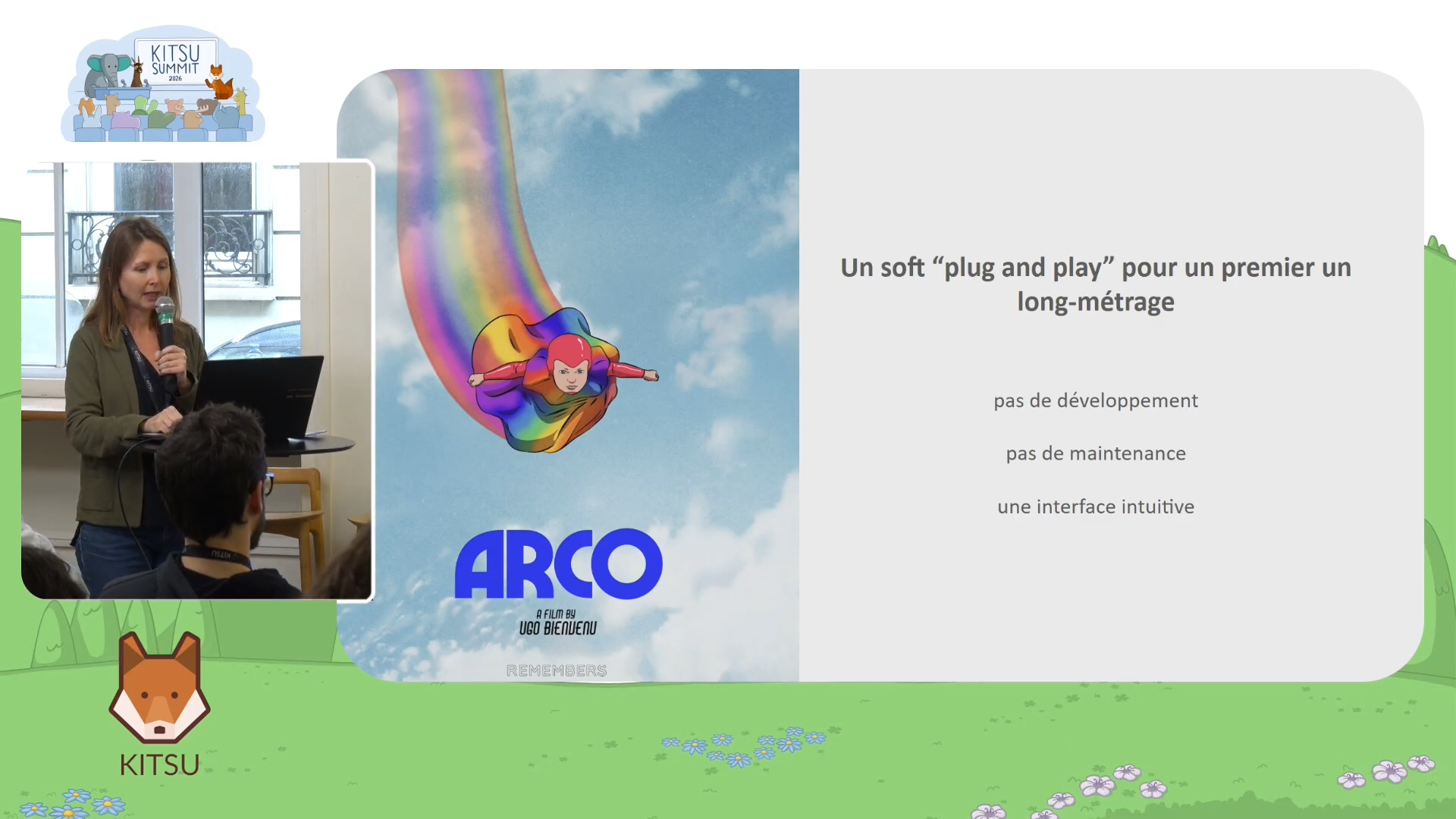
Ftrack and similar enterprise-grade tools require in-house developers to deploy, configure, and maintain. Remembers had none of that: no IT staff, no technical director, no pipeline developer. Bringing in a tool that required that kind of support would have created more problems than it solved.
Kitsu addressed her core constraints from the start. After a demo with the Kitsu team, the studio collectively decided to move forward. The reasons were practical:
- No development required to get started
- No ongoing maintenance burden
- No in-house technical resources needed
- An interface intuitive enough for people picking up a production tool for the first time
"That reassured me greatly. And obviously we were looking for something very intuitive, because since I was addressing people who weren't asking for tools, they needed to be able to pick it up and get on board very naturally."
How Kitsu Worked in Practice
The Artist Experience
Every artist on the production, regardless of which of the three sites they worked from, had a personal page in Kitsu showing all their assigned tasks (rough animation, clean animation, or other), the status of each task, the estimated time allocated, and a running log of time already spent.
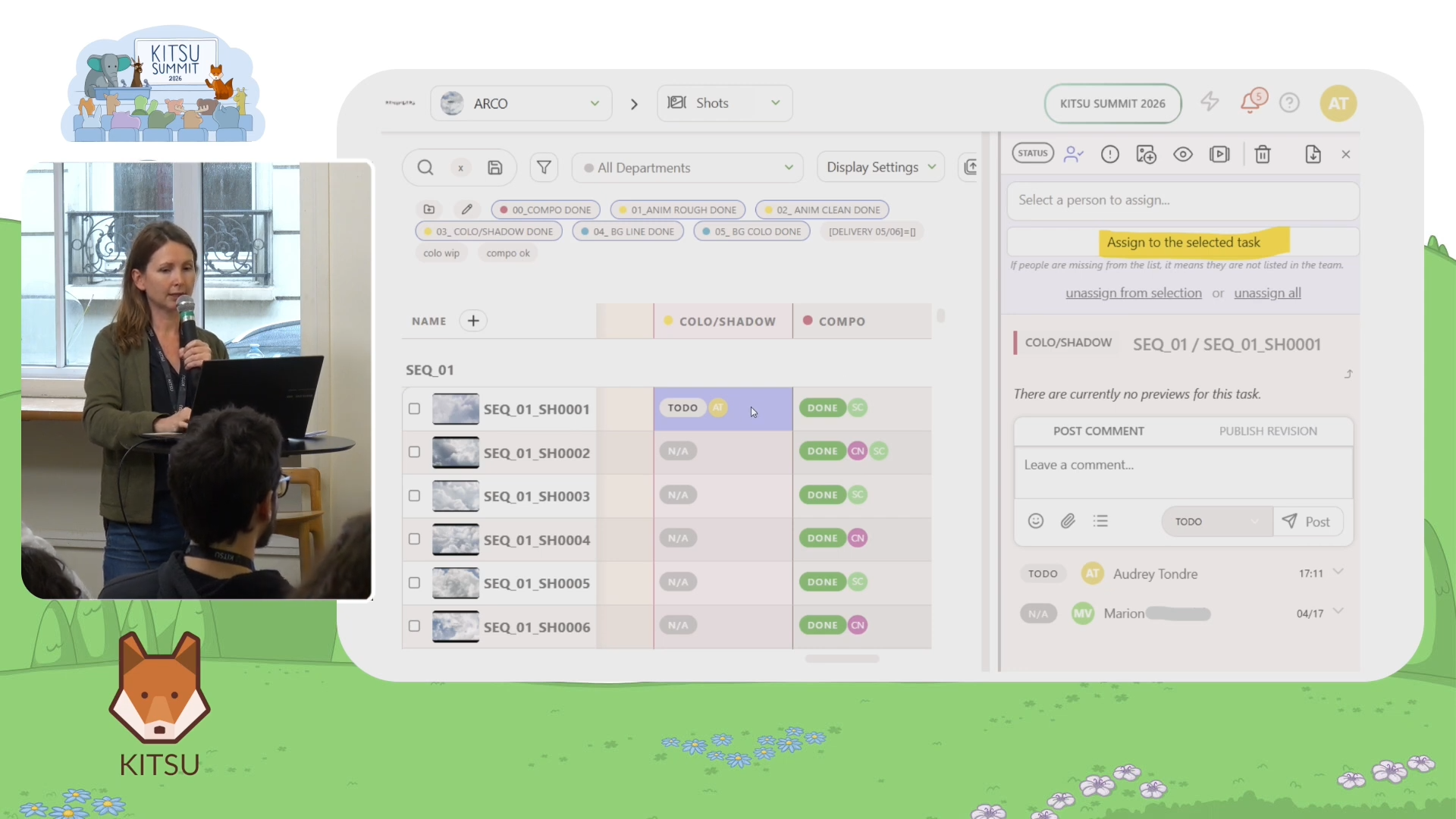
"You can understand that between this and having no tool at all, we've already made an enormous step forward. And it's not just about productivity, it's more enjoyable too."
Viewing a specific version of a shot no longer meant digging through a shared network drive and risking pulling the wrong file. In Kitsu, every version is one click away and tied directly to its comments. That alone removed a significant source of confusion and wasted time.
The Supervisor Experience
Supervisors built their review pages using simple filters. An animation supervisor could filter for all shots currently "waiting for approval," see exactly what needed attention, and post feedback directly on the relevant version. Comments were timestamped, attributed, and version-specific.
"It's very targeted and it works well."
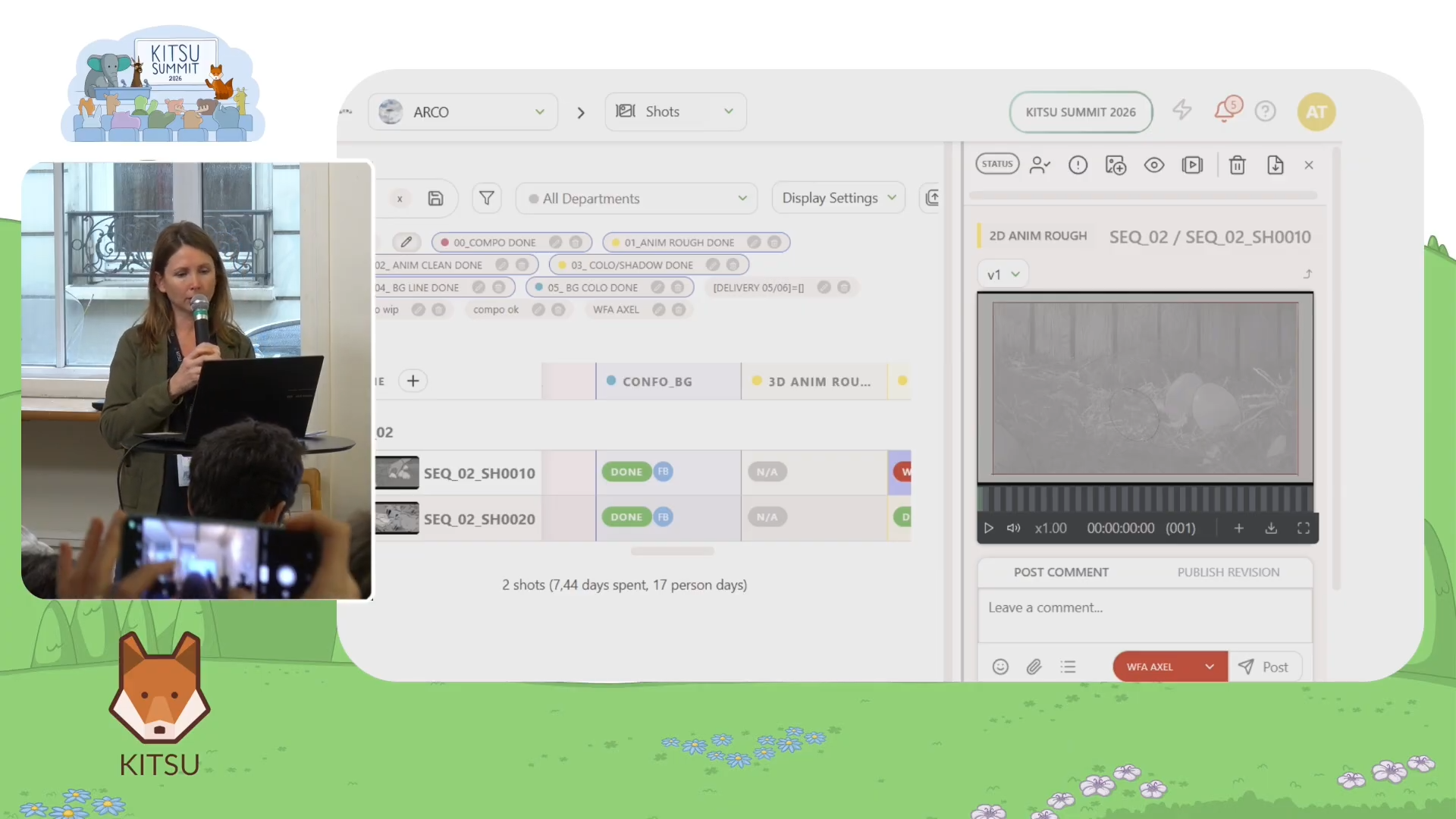
Beyond the functional benefit, Kitsu gave supervisors something less obvious but equally valuable: structured time. Rather than being interrupted throughout the day by artists seeking feedback, supervisors could set aside dedicated review blocks in the morning and afternoon, and spend the rest of their time on their own work.
Cross-Department Communication
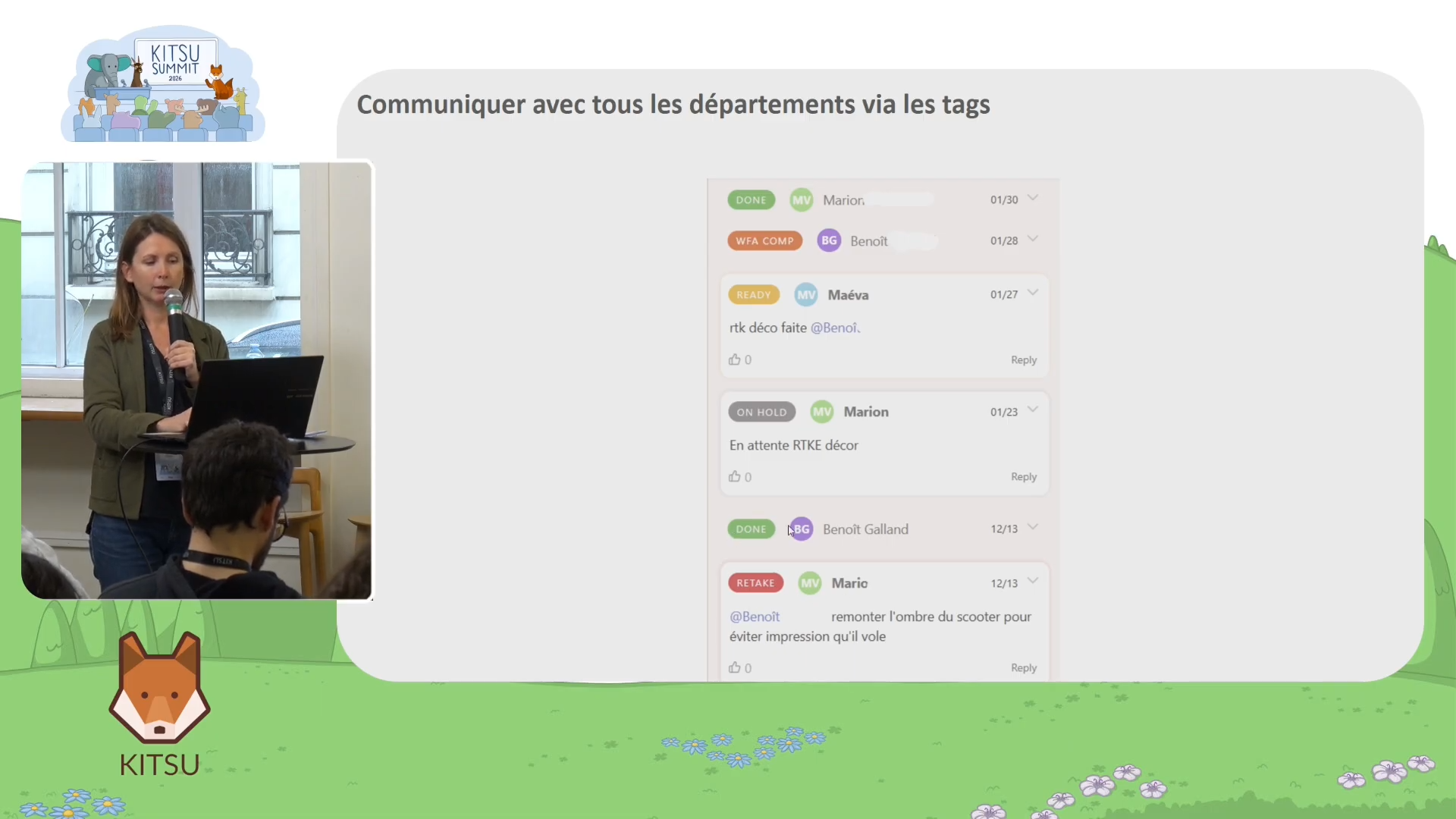
One of the most practical features Audrey highlighted was the ability to tag anyone in the project from within any task comment thread. On a long production where compositing might uncover an issue with a background that had already been approved weeks earlier, this closed the loop quickly.
"Inter-department exchanges are really quite easy and can be quick. Often it's small edits, things that slipped through because the shots had already been approved."
Using Kitsu Data for Production Tracking
The second half of Audrey's talk addressed a concern that production managers with experience in more advanced platforms sometimes raise about Kitsu: the lack of custom-built analytics pages. In tools like Ftrack, you can construct dashboards that process and display data in multiple ways without leaving the platform.
Kitsu does not offer that out of the box. Audrey's response was pragmatic and worth paying attention to.
"In reality, all the data that can be valuable in production tracking does exist in Kitsu. It's just not always visible on pages you'll find ready-made."
Her approach combined two simple steps: export a CSV from Kitsu, then import it into a Google Sheet she had built herself.
Tracking Production Curves
For each major department, she maintained a projected completion curve plotted against time. The vertical axis tracked the number of shots completed, and the dashed line represented the original model. Each week, she exported real data from Kitsu's Sequence Stats page, which shows the exact number of shots in each status across every department. She imported that CSV and the Google Sheet updated automatically.
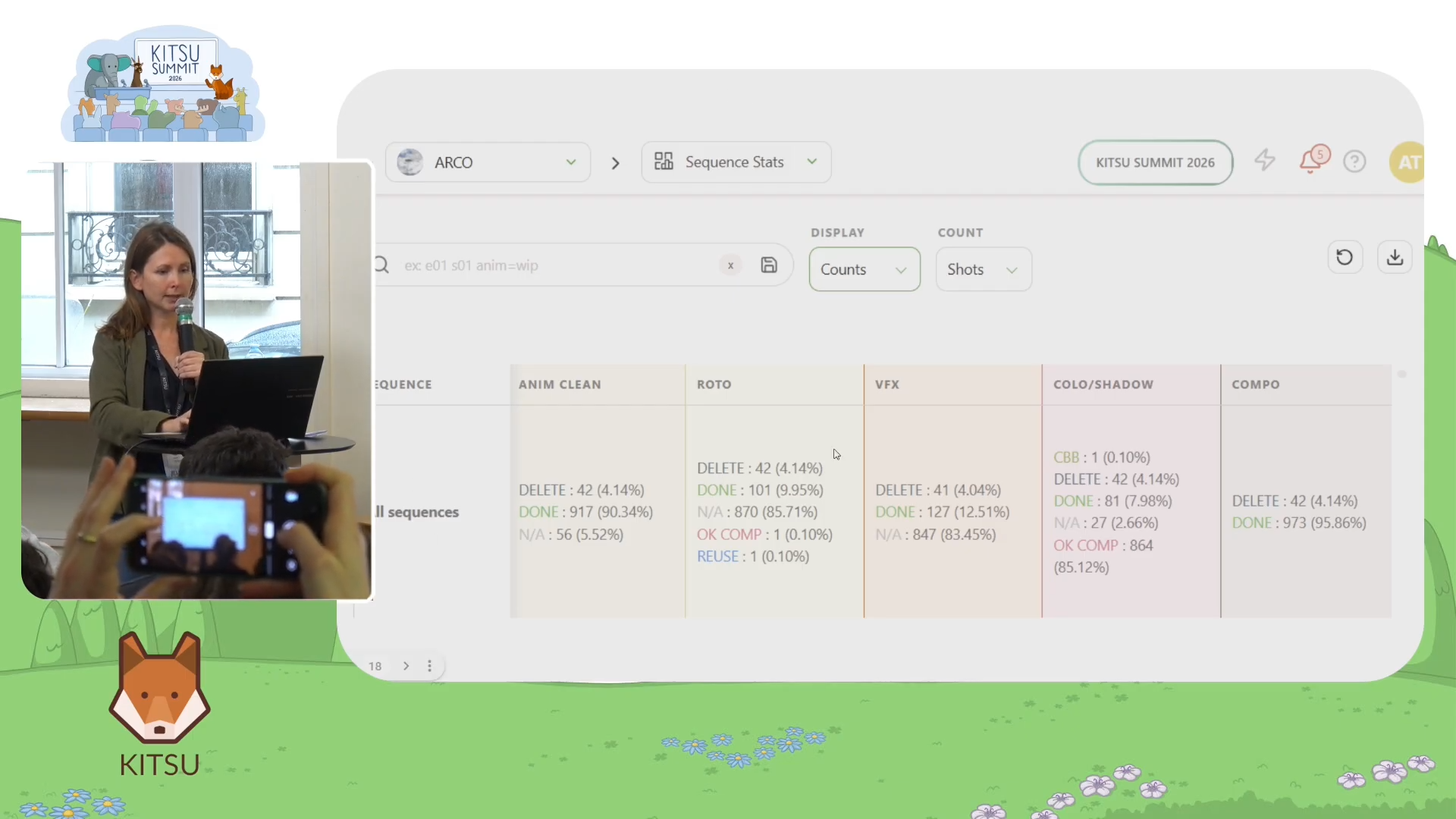
The result was an immediate visual indicator of whether production was tracking to plan or drifting.
"A feature film is a big undertaking with a lot of inertia. If you start drifting for one week, that's okay. Two weeks, you need to look at what's happening."
She also applied a simple weighting system to shots currently in progress. A completed shot counted as one. A shot in editing counted as 0.75. A shot waiting for approval counted as a lower weight. This gave her a more accurate picture of work done rather than just work fully signed off.
Tracking Inventory Between Departments
On a linear production pipeline, each department feeds the next. If animation moves faster than layout, animators sit idle. If compositing falls behind, it creates a bottleneck no matter how far ahead animation is. Audrey tracked inventory levels at each stage: what was fully available for each department, what was still in progress, and what had already passed through.
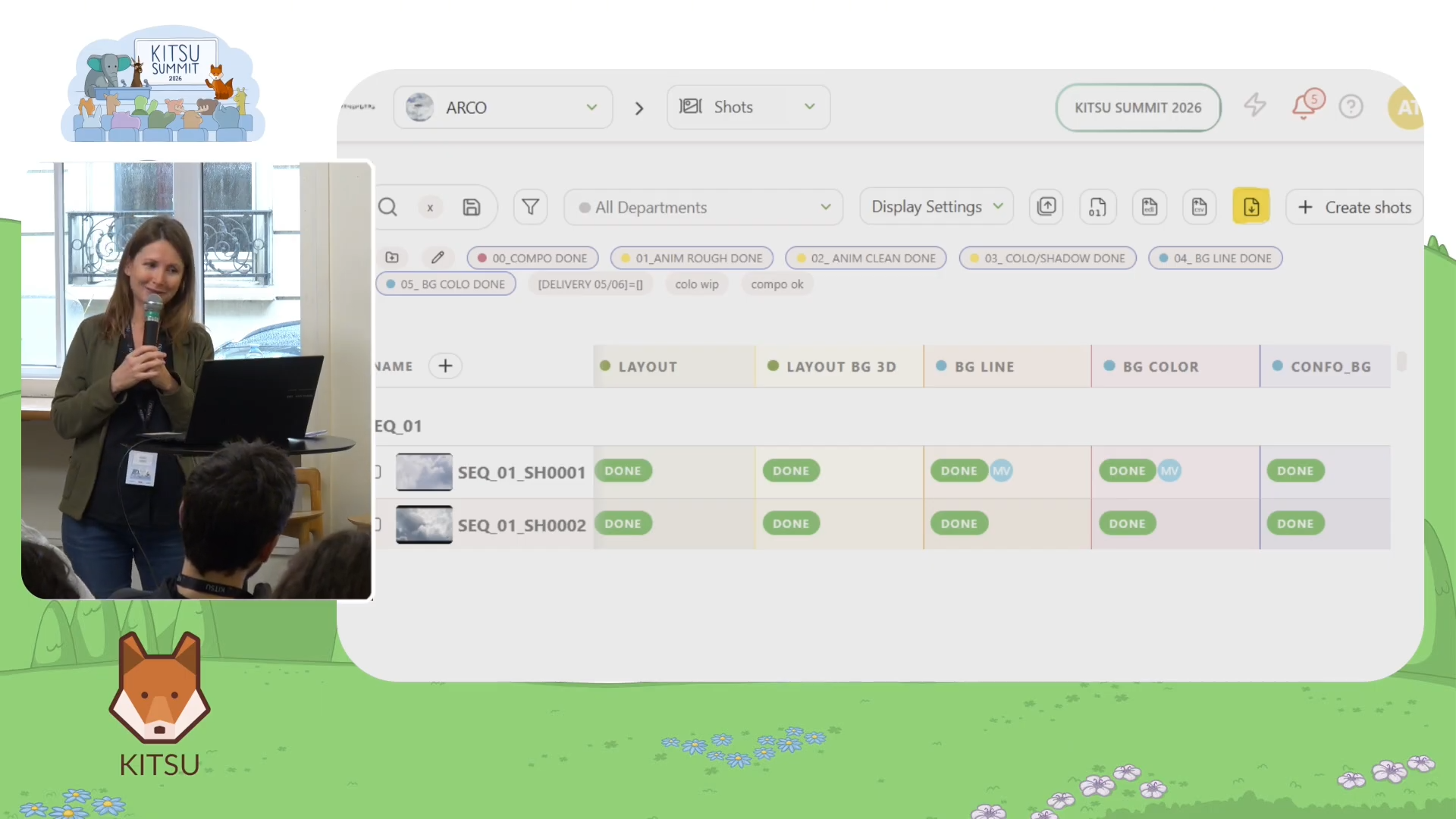
She built a table in Google Sheets with all sequences on one axis and all departments on the other. Cells turned dark green at 100 percent, light green for work in progress, and white when nothing remained. Every cell was formula-driven. No numbers were entered manually. One CSV export from Kitsu's shots page, one import, and the entire table refreshed.
"It lets us ask the right questions: 'Oh, this department is moving a bit faster. Do we need to accelerate the previous one, or can we shift some artists from one department to another?'"
Adoption Was Easier Than Expected
A common worry when introducing new tools to a creative team is resistance. Audrey's experience ran counter to that fear.
She set up Kitsu before the bulk of the team arrived. By the time animators and background artists joined in large numbers, the tool was already in place and populated. They arrived to a working system rather than a work-in-progress.
"Kitsu is something that's very, very easy to pick up. You can click anywhere, you see the film's images, you see all the departments and sequences that might relate to your own."
That last point matters more than it might seem. Artists did not experience Kitsu as a reporting obligation. They experienced it as a window into the broader project. Browsing shots from other departments, seeing the whole film take shape across sequences, made the tool genuinely interesting to use.
"It's also enjoyable and motivating to browse around in the tool. It's not just 'oh, I have to post my latest version.'"
Key Takeaways
Audrey's experience on Arco offers a few clear lessons for animation studios at a similar inflection point.
The absence of a technical team is not a blocker. Kitsu does not require developers, a technical director, or an IT department to deploy and maintain. For small and mid-sized studios, this removes the single largest obstacle to adopting a real production tracking platform.
Simplicity builds adoption. The more complex the tool, the more training it demands and the more resistance it generates. Kitsu's interface allowed a team with no prior experience with production tracking software to get on board quickly and without building up resentment.
The data is already there. If Kitsu does not offer a specific analytics view out of the box, that is not the end of the conversation. CSV exports from the Sequence Stats and shots pages provide all the raw material needed to build whatever tracking logic a production manager requires, in whatever format suits them.
Structure and creativity are not opposites. Ugo Bienvenu's ambition on Arco was to make a film that could almost have been made in the 1950s: beautiful images, precise animation, minimal compositing, and great music. Kitsu did not interfere with that vision. It protected it by keeping the production on track so that the artists could focus entirely on the work.
"The goal was to structure things in the most imperceptible way possible."